


Introduction
Recurring payments are moving beyond the traditional subscription model and becoming a broader monetisation architecture across the economy. As of 2026, the global recurring payments economy is estimated at approximately USD 628 billion and is projected to reach 1.5 trillion by 2033.
The model has expanded well beyond traditional media and software. Today, recurring payments support software-as-a-service, mobility, retail replenishment, digital memberships, creator platforms and increasingly B2B services. Businesses are moving beyond simple flat-rate subscriptions towards more flexible models that combine recurring fees with usage, credits and other forms of variable pricing.
With this growth, the strategic question for payments leaders is shifting from how to process recurring payments to how to help businesses make recurring revenue more reliable, and who will ultimately control the customer and payment relationship.
For payments leaders, the opportunity therefore extends beyond automated collections. As recurring business models become more sophisticated, payments capabilities increasingly influence how revenue is priced, billed, collected and retained from intelligent billing and payment recovery to credential management, customer lifecycle management and regulatory compliance. Recurring revenue may look predictable from a financial reporting perspective, but its reliability depends on the underlying payment infrastructure, customer trust and operational discipline required to sustain it.
Evolution of Subscription Pricing – Case Study: ClassPass
As businesses expand their use of recurring revenue models, subscription pricing is evolving beyond simple flat-rate fees. The next generation of recurring revenue increasingly includes:
- Usage-based billing that aligns price with actual consumption
- Hybrid models that pair a base fee with metered usage
- Credit-based systems that let customers pre-buy flexible allowances
- Dynamic pricing that flexes with demand, time and availability
ClassPass demonstrates how recurring business models evolve when pricing becomes a strategic capability rather than simply a billing mechanism.
When ClassPass launched in 2013, it offered an unlimited monthly subscription, giving members unrestricted access to participating fitness studios for a fixed fee. While the model drove rapid customer growth, its economics proved unsustainable. ClassPass reimbursed partner studios for every class attended, meaning heavy users could generate costs that exceeded the revenue they paid. To address this, ClassPass replaced its unlimited model with a credits-based system in 2016. Under the new model
- Members receive a monthly allocation of credits based on expected usage
- Different activities consume different amounts of credits
- The number of credits required varies based on demand, location, time and availability
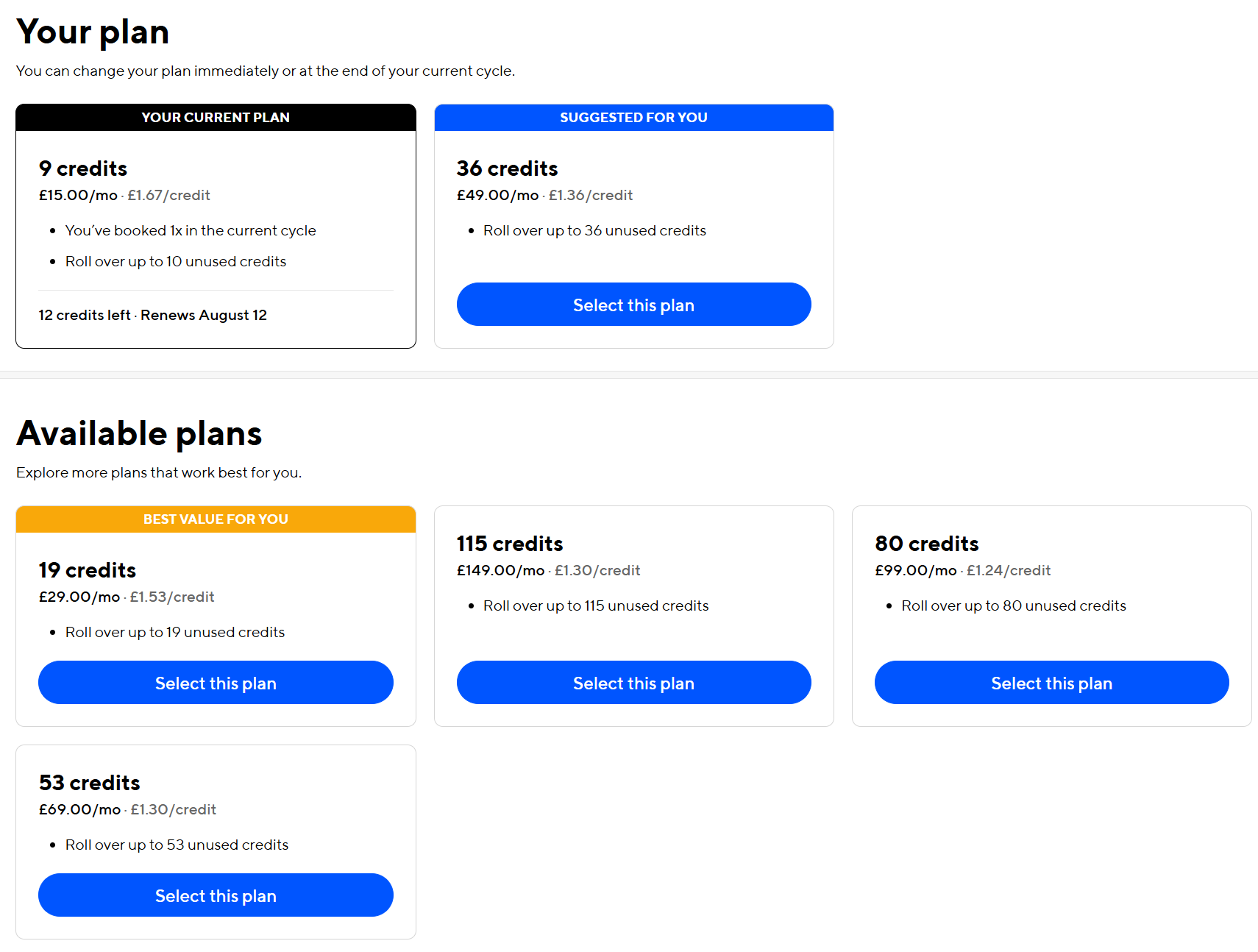
This transformed subscription pricing into a form of yield-management, as seen in airlines and hospitality.
The lesson for payments leaders is that recurring revenue is not simply a collection problem. Pricing, billing and payment capabilities increasingly work together to determine the economics and reliability of recurring revenue.
Where Value Accumulates in the Recurring Payments Ecosystem
Recurring revenue creates new complexity across the payment value chain. Different players control different parts of the journey:
- Merchants own the customer relationship, pricing model and payment consent, and ultimately bear the impact of failed payments and churn
- Billing and subscription platforms manage the subscription logic, including proration, invoicing, entitlements and payment recovery
- Payment orchestrators and gateways route transactions, optimise authorisation performance, and drive recovery through intelligent retries
- Card networks and issuers support the infrastructure that keep stored credentials usable over time, including network tokenisation and account updater services that help maintain payment continuity when cards are reissued
- This creates an emerging strategic battleground around the intelligence layer of recurring payments: the capabilities that connect billing decisions to payment execution and determine whether a recurring charge is successfully converted into revenue.
However, recurring revenue is only valuable if businesses can successfully collect it. Recurring revenue is often treated as contracted and dependable; in reality, businesses remain exposed to:
- Failed payments
- Expired or reissued credentials
- Voluntary cancellations, amplified by price sensitivity and subscription fatigue
- Regulatory intervention on consent, disclosure and cancellation
Additionally, these businesses are also exposed to involuntary churn: revenue lost not because customers actively decide to leave, but because a payment fails. Recurly data covering more than 1,500 subscription businesses shows that 1.25% of subscribers churn each year involuntarily, accounting for roughly one in three lost subscribers.
This makes payment failure a material but often overlooked source of revenue leakage, particularly in lower-value consumer portfolios. Unlike voluntary churn, involuntary churn can be addressed through payment capabilities such as network tokenisation, account updater services and more effective retry strategies. For example, Stripe reports that its Smart Retries recovered 57% of recurring payments that initially failed.1
Authorisation quality also matters. Recurring card payments need to be correctly identified and processed within the relevant stored-credential and merchant-initiated transaction frameworks. In Europe, subsequent recurring transactions can qualify as payee-initiated transactions and, where the relevant conditions are met, do not require SCA for each payment. Correct transaction classification is therefore important both for compliance and for avoiding unnecessary authentication and payment friction.
Subscription Management Moving to the Banking App
As recurring commerce scales, subscription management is emerging as a distinct layer in the payments ecosystem. 2026 research from Mastercard and Datos Insights found that 77% of consumers want to view and manage all their subscriptions through their banking app, while 39% would consider switching banks to access that capability.
Banks, fintechs and card networks are responding by embedding subscription visibility and controls into the account interface. Mastercard's Smart Subscriptions, for example, gives participating issuers tools to provide consumers with greater visibility and control over recurring payments.
For merchants, this creates a new challenge. The customer relationship is no longer controlled solely by the subscription provider. If consumers increasingly manage, pause or cancel subscriptions through their bank or another intermediary, the control point is moving away from the merchant.
The UK market reinforces the scale of the issue. The Government estimates there are 155 million active subscriptions, of which around 9.7 million are unwanted, representing approximately £1.6 billion in annual consumer spending. New rules announced in April 2026 will also require clearer subscription information, renewal reminders and straightforward cancellation, with the regime expected to take effect in spring 2027.
Regulatory Scrutiny is Increasing
As recurring payments become more embedded in everyday commerce, regulatory scrutiny is increasing around how businesses obtain consent, communicate recurring charges and allow consumers to cancel.
In April 2025, the US Federal Trade Commission (FTC) sued Uber over its Uber One membership plan. It alleged that the company enrolled consumers without adequate consent, misrepresented the savings available and made cancellation difficult. The FTC alleged that consumers could be required to navigate as many as 23 screens and take 32 actions to cancel, despite Uber's "cancel anytime" promise. The case remains active: in December 2025, the FTC was joined by 21 states and the District of Columbia in an amended complaint, followed by a further amended complaint in May 2026.
The case highlights four areas of regulatory focus:
- Consumer consent: customers must knowingly agree to recurring charges
- Cancellation: businesses must provide a clear and effective way to stop recurring payments
- Negative-option billing: businesses cannot rely on consumers' silence or inaction as evidence of continued consent where the relevant legal requirements are not met
- Transparency: pricing, renewal terms, billing arrangements and material conditions need to be clearly disclosed
The regulatory position remains unsettled, but scrutiny is clearly increasing. The FTC's 2024 "click-to-cancel" rule was vacated by the Eighth Circuit in July 2025. Rather than ending the debate, the FTC has returned to the issue through a new rulemaking process. In March 2026, it formally sought public comment on whether and how to amend its existing Negative Option Rule to address deceptive or unfair negative-option practices. The Commission is therefore considering changes to the regulatory framework while continuing to pursue individual subscription cases, including Uber and JustAnswer.
For payments and subscription businesses, the practical takeaway is straightforward: recurring revenue can no longer depend on friction. Consent needs to be clear, recurring charges need to be transparent, and cancellation needs to be straightforward.
Implications and Signals to Watch
Recurring payments are becoming an increasingly important monetisation architecture, but the opportunity is not simply to process a greater volume of recurring transactions. As pricing becomes more sophisticated, payment failures become a measurable source of revenue leakage and consumers gain greater control over subscriptions, the competitive advantage is moving towards the intelligence layer between merchant and network.
The implications differ by stakeholder:
- Merchants: treat pricing design, payment recovery and credential management as commercial capabilities, not back-office functions.
- Subscription platforms: differentiate through recovery, tokenisation, retry intelligence and flexible billing, rather than the billing ledger alone.
- Payment leaders: focus on the authorisation and recovery stack, where recurring-specific value and avoidable churn increasingly sit.
There are also several signals to watch over the next 12–24 months:
- Regulation: the FTC's new negative-option rulemaking, the outcome of the Uber case and continued UK and state-level action on subscription cancellation and consent.
- Pricing: continued migration from flat-rate subscriptions towards usage-based, hybrid and credit-based models.
- Payment performance: adoption of network tokenisation, account updater and more sophisticated retry and recovery tools, alongside changes in involuntary-churn benchmarks.
- Value-chain consolidation: further convergence between billing, orchestration and payment recovery platforms, and how networks and issuers monetise recurring-payment capabilities.
- Customer control: whether banks, fintechs and networks increasingly become the primary interface through which consumers manage recurring payments.
The strategic question is no longer whether recurring payments will grow. It is who will capture the value created around them, and who will control the infrastructure that turns recurring billing into reliable revenue.
1 Please note this is a vendor-specific result rather than an industry benchmark
The content of this article does not reflect the official opinion of Edgar, Dunn & Company. The information and views expressed in this publication belong solely to the author(s).
Beatrice is a Senior Consultant based in EDC’s London office. Since joining EDC in 2020, Beatrice has developed valuable payments expertise by working on projects for payment schemes, merchants, payment service providers, travel industry stakeholders and Fintech companies across various regions, including Europe, North America, Latin America and APAC. Beatrice holds a double MSc in Business Management from the National University of Singapore (NUS), Koç University Istanbul and HEC Paris, as well as a double BA in Business Management and Marketing. Outside of work, Beatrice has a passion for travelling, Latin dancing, with a focus on bachata and salsa, and is an avid gym-goer.
%20(1).webp)

%20(1).webp)

.webp)

