


B2B payments are being quietly reshaped by a powerful new layer of fintech infrastructure: issuing Software-as-a-Service (SaaS) platforms.
While often operating behind the scenes, these platforms are enabling fintechs, banks and corporate program managers to launch commercial card programs faster, more flexibly and with significantly lower investment than traditional issuing models. As embedded finance, virtual cards and spend management continue to expand, issuing has become a strategic capability rather than simply a banking function. This article explores the issuing SaaS landscape, explaining where these platforms sit within the commercial card value chain, how they differ in their capabilities and business models, and why they are reshaping the economics and competitive dynamics of B2B payments.
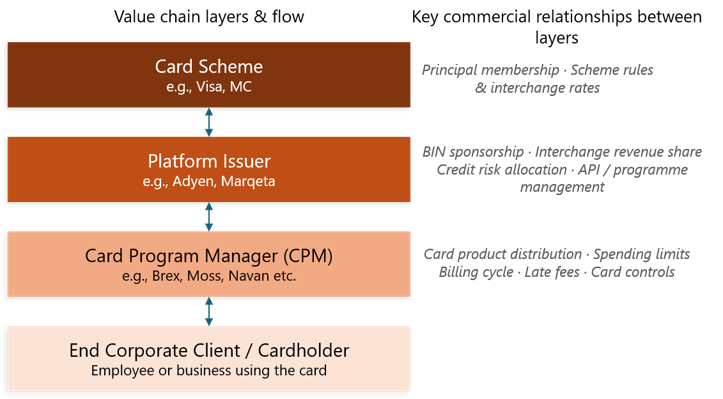
Also called Card-as-a-Service (CaaS), SaaS platforms provide the infrastructure to launch card programs, and represent one layer of the value chain, together with the card schemes, card program managers and the end corporate clients, as represented in Figure 1. SaaS issuing platforms provide the BIN sponsorship, the processing rails and in some cases credit capabilities to Card Program Managers, which design, launch and distribute card programs to end corporate clients.
Issuing as a strategic and economic layer
This alternative value chain signals a shift to a different type of issuing, traditionally controlled by banks and now increasingly becoming programmable and software driven. Businesses are now able to create, manage and control physical and virtual cards - through APIs - that are personalized for their brands , without the need to become a bank.
Other than technological, the main driver for this shift is economic: Card Program Managers who distribute cards capture a share of interchange fees, access transaction-level data, and control approval rules. Historically, this value has been captured primarily by issuing banks and card networks. Card Program Managers redistribute part of this economics to end corporate clients, turning card issuance into a direct revenue and data opportunity.
Thanks to the infrastructure provided by SaaS issuing platforms, Card Program Managers are now internalizing significant parts of the issuing stack themselves, including underwriting, credit and, in some cases, even issuer processing. SaaS platforms can play different roles on credit, either managing credit risk in-house, or relying on bank partners. This has an impact on the overall economics available to the Card Program Managers, as an additional party needs to be compensated in the value chain. Some Card Program Managers have developed the ability to manage credit internally, outsource it to a bank or sell receivables to third parties. Moreover, some larger Card Program Managers have even obtained their own BIN sponsorship (becoming Visa or Mastercard principal members) and negotiate directly with schemes, bypassing the SaaS issuing platform layer entirely, and using it only for processing.
Competitive dynamics
Competition among SaaS issuing platforms is intensifying and core issuing capabilities are becoming standardized. SaaS issuers can be split into two categories:
- Issuing SaaS platforms, such as Stripe, Marqeta and Adyen, which solve the complexity of working with sponsor banks and card networks usually faced by businesses
- Banks, which are moving into APIs .
Moreover, payment schemes are supporting issuers through partnerships. For example, Unipaas, an embedded payments provider for SaaS platforms based in the UK, announced a partnership with Mastercard , and Visa announced a partnership with Mynt, a SaaS spend management solution from Sweden.
Competitors differentiate in three dimensions:
- Depth of integration: platforms that are embedded directly into business workflows (such as ERP, procurement, or expense management systems) are more likely to become the default layer for payments
- Geographic and regulatory coverage: the ability to issue locally, in multiple currencies, and across jurisdictions without relying on cross-border setups is becoming a key differentiator to assist international corporates or end clients expanding internationally
- Scale advantages: platforms that process higher volumes of transactions can continuously improve spend controls, fraud detection, and authorization decisioning and can price more competitively
- Flexibility and configurability: the ability to tailor card programs, spend controls, approval workflows to specific client needs
- Customization for specific industry verticals: the ability to embed card programs into existing business workflows - for example, through integrations with industry-specific ERP, accounting or procurement systems, for industries with complex spending processes such as construction, media or travel.
Also Card Program Managers are facing increasing competitive levels, with the market being fragmented across customer segments (e.g., fintechs embedding payments into their products, corporates willing to control more closely employee spend) and use cases (e.g., corporate expense management cards, virtual cards for T&E).
Winners in this space are likely to be those that combine distribution through software ecosystems with scale in transaction data and global coverage for large international clients.
Payments as a control layer
Card Program Managers not only enable businesses to create payment cards in a faster way, but also to manage and control them. Hence, they turn payments into control layers, i.e. sets of programmable rules, such as spend limits and controls, and blocked merchant categories , rather than a passive recording of spend.
These advantages have unlocked new B2B use cases:
- Construction companies can issue restricted virtual cards for subcontractors
- Procurement platforms can generate virtual cards that are assigned to specific transactions or vendors
- Marketplaces can issue cards to sellers, which enables them to access earnings instantly .
Another key differentiator for end corporate clients is access to data. Through richer reporting and analytics capabilities, businesses can monitor program performance, identify opportunities to optimize spend policies, and conduct ad-hoc analysis and audits with greater efficiency. This transforms card programs from simple payment instruments into tools for spend visibility, control and operational decision-making.
This trend is just a small part of a more general evolution: financial services are getting unbundled from banks and rebuilt as modular software parts. Card issuing is especially powerful because platforms that own the payment instrument are able to benefit from data access and transactions control. These two elements can be used as revenue generator, together with interchange, to re-think the value chain and develop strong financial returns.
Card Program Managers are becoming financial gatekeepers, and this is rebalancing the role of some banks, which face the risk of gradual reduction in margins, although remain essential for providing licenses, underwrite credit risk and maintain direct relationship with the schemes. Large technology providers were able to adapt to this and still be important competitors in the market. Their scale and principal membership with Visa and Mastercard allow them to design more sophisticated BIN programs (aligning transactions with more favourable interchange categories) that achieve better effective interchange yield at the transaction level.
As Card Program Managers continue to scale and internalize key components of the issuing stack, the balance of power is shifting - not only away from traditional banks, but also within the issuing ecosystem itself. The competitive advantage is no longer in processing transactions, but in controlling how, when, and why payments happen. Incumbent players have opportunities to strengthen their role, while new entrants can create innovative value propositions and generate profitable business models.
At Edgar, Dunn & Company, we work with issuers and stakeholders across the entire issuing value chain. Our experience in recent projects has highlighted significant opportunities to generate strong revenue streams. However, success depends on the definition of a clear and differentiating value proposition and a sound go-to-market strategy, including partnerships and vertical-specific solutions that enable providers to differentiate and win targeted segments.
The content of this article does not reflect the official opinion of Edgar, Dunn & Company. The information and views expressed in this publication belong solely to the author(s).
Elisabetta is a Consultant based in London. Prior to EDC, she worked as a research fellow at SDA Bocconi University, in Milan, focusing on the analysis of entrepreneurial decision-making processes. Elisabetta holds a MSc in Economic and Social Sciences from Bocconi University in Milan and a BSc in Economics from Ca’ Foscari University of Venice. In her free time, Elisabetta loves cooking (and eating) and practicing different sports, including climbing, hiking, and swimming.
%20(1).webp)

%20(1).webp)


.webp)

