
.webp)

Grocery shopping has long been a routine activity for households, involving the purchase of food and essential goods either in-store or online. Historically consumers have bought from specialist stores, such as butchers, bakers, and food markets. The term "grocer" originated in the 14th century, referring to wholesalers of dry goods such as spices and tea. The modern supermarket model first appeared in the USA around the 1930’s and rapidly expanded across developed markets through the 1950’s. These typically combined multiple departments (meat, produce, dry goods, household essentials, etc.) under one roof.
The first recorded "online" grocery order was placed in 1984 by 72-year-old Mrs. Snowball in the UK. As this was pre-internet and pre-ecommerce, she used a system called “Videotex”, which connected her television to a local Tesco supermarket via a telephone line. Her order was processed by the supermarket and delivered to her door, where she paid in cash. Perhaps the first non-digital payment method; cash on delivery!
It was not until the late 1990s, during the dot-com boom, that grocery e-commerce saw massive investment, dominated by two different business models (a) the pure-play e-commerce businesses, such as Webvan and Peapod, and (b) the established bricks-and-mortar supermarkets, who created their own home-delivery divisions to address consumer demand.
Enter the era of agentic grocery shopping
In the last 30-odd years, e-commerce grocery shopping has evolved, but the core journey has remained largely unchanged, until now. "Agentic" grocery shopping is expected to shift from active searching, i.e., a consumer browsing apps or a website, to autonomous delegation where an AI agent makes decisions on behalf of the consumer. Grocery shopping is highly repetitive and largely functional, making it well suited to automation. As such, many consider it one of the “ideal” retail segments for the rapid adoption of agentic commerce.
In practice, this could shift part of grocery shopping from a manual chore to a more “ambient service” that happens in the background. Unlike fashion apparel or consumer electronics, groceries involve low decision-making costs, short purchase cycles, and the added complexity that many items have an expiration date. An AI agent that can learn a household’s consumption patterns and auto-orders the right quantity at the right time could deliver meaningful convenience for many households, even though adoption may be more gradual for categories where preferences, freshness, or brand loyalty play a stronger role. This is effectively predictive replenishment.
Predictive replenishment is not new. In many B2B domains, the use of AI, machine learning, and real-time data to anticipate inventory needs before they occur, has helped shift operating models from a reactive restocking to proactive inventory management. Predictive replenishment lowers carrying costs, reduces stockouts, and enhances supply chain efficiency. When integrated with logistics, it also helps ensure that materials and goods are delivered just in time. This approach is widely used across industries, from construction sites to automotive manufacturing. Applying these capabilities to household consumption by combining predictive replenishment with agentic commerce represents the next stage in the evolution of e-commerce. Grocery shopping is about to get interesting.
Emerging Case Studies – A is for Amazon or Agentic
In April 2025, Amazon launched a "Buy for Me" feature allowing an AI agent to purchase products from other brand websites while staying within the Amazon shopping app, using a customer's encrypted, saved information. Currently only available in the US, the feature enables AI agents to complete purchases on behalf of consumers, handling the checkout process using Amazon's address and payment methods, even when the item is on a third-party site. The "Buy for Me" feature does not currently work for Amazon Fresh.
However, this is likely just the tip of the iceberg, according to Amazon they are expected to invest over $200 billion in 2026 alone as part of a massive "AI build-out" phase. Rufus, Amazon’s AI shopping assistant, which first appeared in 1996, is expected to see significant upgrades. It will be able to proactively find deals, manage price alerts, and reorder everyday household items, such as dishwasher tablets, toilet paper or washing powder.
These developments would make Rufus significantly more sophisticated than earlier initiatives such as Amazon Dash Buttons, which were introduced in 2015. The Dash Buttons, which didn’t really gain widespread adoption, were small, Wi-Fi-connected plastic fobs, with a single button, designed to be stuck near household items (e.g. on a washing machine or inside a pantry). They allowed Amazon Prime customers to reorder specific products, such as washing detergent or toilet paper with a single press, effectively a “human-in-the-loop” approach to replenishment.
There is no doubt that Amazon has deep pockets when it comes to investments in AI. In 2025, it stated it had invested a total of $8 billion in Anthropic, the company behind Claude. In February 2026, Amazon announced a $50 billion multi-year partnership with OpenAI. And Amazon’s broader AI investment strategy extends well beyond the examples covered here.
The implications for the average shopper are likely to be experienced via Rufus. It is expected to evolve from a conversational AI assistant into an agentic shopping companion that can perform tasks on the behalf of the user. Users could instruct Rufus to monitor prices and automatically purchase an item once it reaches a specific target price. Rufus could then transcribe a handwritten grocery shopping list and automatically add items to the Amazon cart. While not fully agentic, these capabilities form part of a broader roadmap of new AI-related enhancements that Rufus will receive in the next 12 months.
The other big retailer – Walmart (US)
Like Amazon, Walmart is aggressively investing in agentic commerce and artificial intelligence, shifting from "AI-assisted" to fully autonomous "agentic" systems designed to act on behalf of customers, employees, and partners. Just when you got to know Rufus, meet Sparky, Marty, Wibey and Wally. All new AI agents from Walmart’s AI and agentic R&D labs.
Sparky is a customer agent, a generative AI assistant found inside the Walmart app. It synthesizes reviews and suggests products and is expected to evolve into a full agentic assistant capable of reordering essentials, planning complex events – such as a party. It can even suggest recipes based on photos of the inside of a consumer’s fridge. Sparky is part of Walmart's broader strategy to integrate AI into its operations to enhance productivity and personalise the shopping experience.
Marty, Wibey and Wally are not consumers-facing but are designed for Walmart employees and partners. They can assist Walmart suppliers, sellers, and advertisers with onboarding, order management, and support ad campaign launches. Wally is a generative AI-powered assistant launched by Walmart in March 2025 to assist internal merchandising teams. It acts as an intuitive data analyst, processing complex sales, inventory, and pricing data via a chat interface to help merchants make faster decisions on product assortment, pricing, and stock levels.
Kroger (US)
Kroger, one of the largest retail and grocery retailers in the US, has made shift in its AI strategy. It has recently moved away from capital-heavy centralised robotic warehouses toward agentic commerce. Kroger expanded its partnership with Google Cloud in early 2026 to deploy a personal shopping assistant using the Gemini Enterprise for Commerce platform.
The consumer agent from Kroger helps families find meal ideas, plan their weekly menus through conversation and allows shoppers to build a grocery basket and place orders faster than traditional search-based journeys. These capabilities represent an initial step toward more agentic forms of commerce.
Carrefour (France)
Carrefour is positioning itself as a leader in AI through its "Carrefour 2030" plan. It stated, in March 2026, to be one of the first European grocery retailer to offer shopping capabilities directly through a ChatGPT interface. It allows customers in France to browse, receive personalised recommendations, build shopping baskets, and select delivery options, with the final purchase completed on Carrefour’s site.
While some features are still experimental, it represents a tangible use case beyond a simple PR stunt.
A video appeared on TikTok shared by Carrefour’s CEO Alexandre Bompard in March 2026, where he personally presents the new "agentic" experience. He showed himself using ChatGPT to plan a meal. Instead of just giving a recipe, the AI checks real-time inventory and builds a shopping basket for him.
Tesco (UK)
Tesco’s agentic commerce strategy focuses on moving AI from chatbots to high-impact, autonomous systems integrated into daily operations. Their primary offering is a suite of AI-driven tools developed through a major three-year strategic partnership with Mistral AI, signed in December 2025. Mistral AI is a French artificial intelligence company, founded in 2023, specialising in highly efficient large language models (LLMs).
This partnership includes a joint "AI lab" for developing custom tools, aimed at accelerating data analysis, enhancing personalisation for Clubcard users, and improving efficiency for staff and suppliers. Again, like Walmart, Tesco’s investment in AI and agentic commerce is part of a broader integrated AI strategy spanning both customer-facing and back-office operations.
Battle of the shopping agents
Rufus is expected to be competing with other consumer-facing agents to capture user engagement and influence purchasing decisions. On the other hand, there are non-retail AI agents being developed by tech giants such as Google, Open AI, Perplexity and Anthropic that are getting ready for the battle of the shopping agents.
Cease-and-desist letters have already been issued by the lawyers, and the battle of the agents is expected to last for some time while the tech companies grab land and claim what is expected to be a multi-billion-dollar market. Effectively a subsegment of e-commerce – to be called a-commerce (“a” for agentic).
Grocery shopping in the future
While celebrity chefs have long been part of supermarket marketing campaigns (such as Jamie Oliver for Sainsbury's), the move toward agentic AI -where AI acts as an autonomous agent to research, shop and personalise food purchases - is currently being led by grocery retailers, technology startups and retail platforms rather than individual chefs.
This may evolve, as AI agents could shift recipe-based shopping from a manual task to an autonomous, "agentic commerce" experience, handling everything from menu planning to checkout. AI could sync with health apps to recommend meals that specifically address nutritional needs, such as lowering cholesterol, increasing protein, or avoiding gluten.
In the future, the consumer’s personal AI agent could interact directly with a retailer's AI agent to secure the best loyalty rewards, coupons, or personalised discounts. At EDC, we expect this could come full circle and celebrity chefs will promote AI-ready recipes, on television and through their recipe books, for the consumer’s AI agent to automatically generate and purchase the required ingredients.
In summary
Agentic systems can automate repetitive grocery tasks such as basket-building, replenishment, learning from past purchases and preferences, price comparison, and checkout. A grocery shopper could instruct their AI agent to “keep the household stocked under a budget,” and it would assemble, compare, and complete the order with far less manual intervention.
In practice, EDC believes the weekly grocery shop is expected to be split into three directions each running side-by-side:
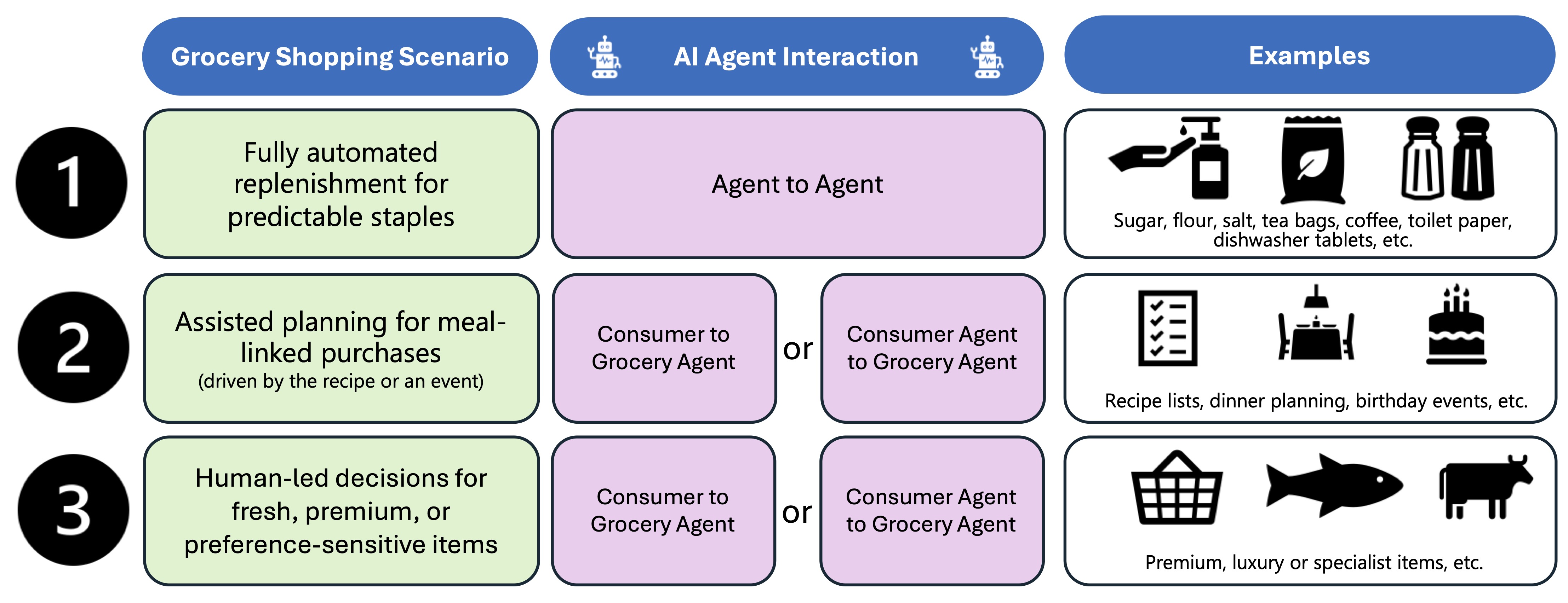
Agentic commerce for grocery shopping will be a paradigm shift toward an intent-driven, frictionless flow, optimised and personalised, based more on data-driven decisions than traditional brand marketing. Baked Beans may no longer have to mean Hienz Baked Beans. Today, supermarkets are investing millions to ensure their shoppers continue to engage with their platforms through AI-driven experiences.
The content of this article does not reflect the official opinion of Edgar, Dunn & Company. The information and views expressed in this publication belong solely to the author(s).
Mark is a Senior Advisor in the London office and heads up the Retailer & Hospitality Payments Practice for EDC. He has over 25 years of experience of consulting strategy in the payments and fintech industries. Mark works with leading global merchants, and payment suppliers to retailers and hospitality merchants, to develop omnichannel acceptance strategies. He uses the 360° Payment Diagnostic methodology developed by EDC to identify cost efficiencies and new growth opportunities for retailers and hospitality merchants by defining an appropriate mix of payment methods, acceptance channels, innovative consumer touchpoints, and optimizing Payment Service Providers and acquiring relationships. Outside the payments and fintech industry Mark is a passionate snowboarder.
%20(1).webp)

%20(1).webp)
.webp)


