

.jpg)
Introduction to Agentic Commerce
Agentic commerce is an emerging commerce model that allows consumers to delegate the end-to-end purchase journey to AI agents. These agents work on behalf of the consumer and can significantly reduce human interaction, but today’s systems still rely on explicit confirmations, payment authentication, and clearly defined guardrails. In practice, an initial prompt plus occasional refinements and approvals is often all that is required for the purchase journey, with truly end to end autonomous experiences remaining more of a forward looking vision than a mainstream reality at the moment.
Upon receiving a request (whether this is an actual purchase or product discovery), the AI agent will autonomously query structured data sources, APIs, and web content to return a set of matching goods/services to the consumer. In today’s assisted agent flows, the user selects their preferred option, reviews the key details, and authorises the payment within a set of guardrails, whilst the agent handles execution and follow‑up tasks (human-in-the-loop). Over time, this could evolve towards fully autonomous flows in which the agent makes and executes purchase decisions within pre‑agreed limits, with no real‑time human interaction required. However, widespread adoption of fully autonomous flows will depend on how authentication requirements, liability allocation, and fraud controls evolve.
Agentic commerce is not just an evolution of the current commerce model; it is a fundamental change that reorders the interconnected parties within the customer journey framework. Based on internal EDC estimates, it is projected to potentially capture around 30% of the total e-Commerce market size by 2030, at a CAGR of 185%1.
FIGURE 1: Agentic Commerce Consumer Journey
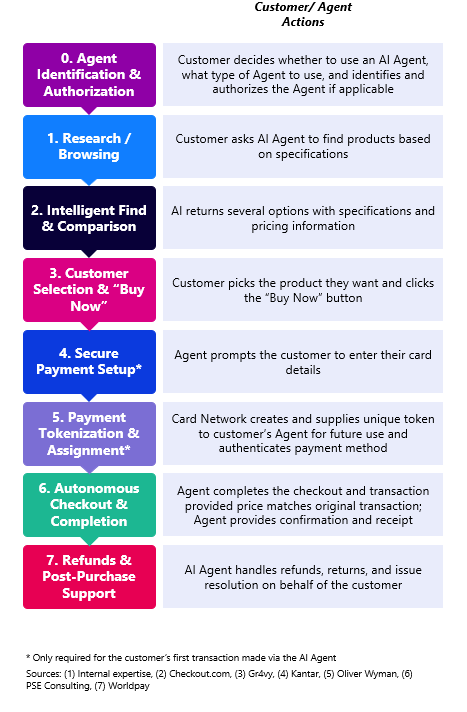
Agentic commerce requires a distinct infrastructure layer that can support increasingly automated transactions. Agentic commerce momentum accelerated in 2025; however, many of the announcements and infrastructure launches only took place within the last quarter of 2025. These announcements came from a variety of payment companies, including payment processors, card networks, technology and AI companies.
Key Protocols

Who controls the checkout
Agentic commerce redistributes control at checkout, shifting some aspects away from the merchant's front end towards the AI agent and its platform. Merchants will continue to have significant control, however, through pricing, inventory, promotions, payment acceptance, and checkout requirements. Unlike the traditional consumer journey, the agent will arrive at the merchant’s website with a preferred product and payment method already chosen. This means that the merchant has reduced influence over discovery and selection, even though they still control pricing, promotions, and acceptance rules.
Control over research and discovery can move upstream into the agent environment. Rather than entering the merchant’s site via search, ads, or direct navigation, the consumer delegates the shopping task to an AI agent that scans multiple merchant sites and marketplaces. The agent applies the specific prompt/instructions given by the user to select the most appropriate product and merchant for the consumer to interact with at the checkout stage. The user can choose the level of detail they give within their prompt to the agent, and will typically specify price, delivery speed, product specifications, and loyalty. In these journeys, the agent interface becomes a key entry point alongside traditional channels, making the agent platform an important funnel for traffic and conversion, but not the only one.
This shift can make the checkout stage itself more standardised across merchants and more compressed compared to traditional e-Commerce. Instead of multiple funnel pages that guide consumers all the way to the point of purchase, the checkout stage may simply be a confirmation screen shown by the agent to the consumer, supplemented by any additional merchant steps required for authentication, fraud checks, or regulatory compliance.
Mastercard’s Agent Pay and Visa’s Trusted Agent Protocol are two payment protocols that are designed to move much of the checkout control upstream into the agent and protocol layer, whilst still plugging into existing merchant systems, acquirer setups, and issuer authentication and risk controls.
At the same time, important constraints remain. In Europe, Strong Customer Authentication (SCA) and 3D Secure typically require the individual cardholder to actively authenticate online card payments, reintroducing human interaction into flows that agents attempt to automate. Even where exemptions and low‑risk models are available, many transactions will still prompt additional authentication in the near term, limiting how fully autonomous checkout can be.
Who controls the payment choice?
In traditional e-Commerce, the human shopper makes the decision on which payment method to select based on the options presented by the merchant. Here, the merchant has an element of power to “steer” the consumer towards a certain choice, for example, by offering discounts or pre-selecting a default choice. In the agentic commerce model, the AI agent increasingly acts as the primary decision-maker, choosing the most-preferred payment method that both reflects the consumer’s instructions and is accepted by the merchant.
The consumer will typically specify the following criteria when it comes to the most-preferred payment method:
- Total cost to the consumer
- Available discounts
- Loyalty benefits
It is then up to the agent to pick the payment method that most closely aligns with the specifications above, within the constraints of what the merchant makes available. Over time, with the user’s permission, the agent can also use transaction history data to learn which payment methods are used more in certain contexts and refine the recommendations accordingly.
The agent is essentially responsible for enforcing the consumer’s preferences, meaning control is shared between the two. The consumer still has primary control since it is on them to give specifications to the agent, but crucially, the merchant has reduced ability to influence within the available options.
Constraints around fraud and liability will also shape how far agents can optimise payment choice. In markets with strong consumer protections and card‑not‑present chargeback rights, merchants may be cautious about fully supporting unattended agent‑initiated payments without clearer standards for demonstrating user intent, which could slow adoption in higher‑risk segments.
Who controls loyalty?
With the introduction of agents, whilst loyalty itself is still ultimately controlled by the merchant, control over how loyalty is used shifts to the AI agent. Merchants are responsible for driving loyalty, and they do this by creating brands that consumers align with and feel a connection to. These drive repeat purchases and allow the merchant to build a direct relationship with the consumer.
With AI agents, control over how loyalty is used can shift towards the agent. Where integrations exist, an agent could aggregate a user’s loyalty programmes, track balances and status, and suggest when to apply points, even though loyalty ecosystems remain fragmented. At checkout, the agent could propose whether to spend points now or, for example, switch to a different merchant where a 3x points promotion or better earn rate is available, ensuring the user does not need to manually calculate the trade‑offs each time. Depending on the regulation, some of these decisions might remain recommendation‑only rather than fully automated. The agent effectively optimises the consumer’s loyalty opportunities by reallocating spending to whichever merchant delivers the highest return.
Consumer data and insights also move upstream to the agent platform. Where users grant permission, and data‑sharing is allowed, the agent platform can aggregate loyalty and transaction signals across participating merchants and payment methods to build a more complete view of a consumer’s loyalty behaviour. In practice, this will be constrained by privacy requirements, data‑sharing agreements, and technical integration limits, meaning that many agents will only see a partial view of a consumer's behaviour rather than a truly comprehensive picture.
FIGURE 2: The Loyalty Triangle

Final Thoughts and Implications
Agentic commerce redistributes control across the transaction flow, changing every stakeholder’s role compared to the traditional commerce flow. For merchants, the most important shift is that the decisive moments in the journey – discovery, evaluation, and increasingly checkout – may move into the agent environment. Instead of solely targeting humans, merchants must ensure their platforms and flows are “agent-ready” and will rank high in their decision logic. That implies investment in high-quality, structured product data, agent-facing APIs, and participation in emerging agentic commerce and payment protocols.
For regulators and policymakers, the rise of autonomous agents exposes gaps in existing frameworks around consent, authorisation, and liability. The question of liability is especially relevant; when an agent misinterprets a user’s instruction and buys the wrong item, today’s frameworks offer little clarity on whether the consumer, the agent’s platform, or the merchant ultimately bears the risk.
In Europe, this challenge is compounded by SCA, which assumes an individual cardholder actively authenticates most online card payments, typically via 3D Secure. As a result, a fully autonomous experience will usually still trigger a 3DS challenge for the buyer, taking away the element of complete autonomy. Whilst limited exemptions and off‑session models exist, they do not yet accommodate general‑purpose agents making purchases on a user’s behalf. In the United States, where PSD2/SCA does not apply, existing card‑not‑present chargeback rules often provide strong protections for consumers, especially where there is limited evidence of cardholder involvement. As a result, many merchants are likely to be cautious about fully agent-driven purchases without clearer standards for demonstrating user intent and allocating liability.
Privacy and data access will also ultimately decide how quickly agentic commerce evolves. If agents depend on broad access to transaction, browsing, and loyalty data, regulators and platforms will need to decide how far such access should extend.
Taken together, these shifts suggest that the core question: “Who controls checkout, payment choice, and loyalty?” no longer has a single answer; control is now shared across several stakeholders. The consumer sets high-level preferences and limits, the agent turns those preferences into concrete decisions, the platform hosts the agent and manages access and data, the merchant fulfils the order, and the payment provider keeps the underlying payment rails secure. Parties that succeed will treat agents as a new primary customer interface that requires transparency, have agent-readable information and platforms, and built in trust at every stage of the transaction.
Interested in discussing Agentic Commerce and how this emerging trend could affect your organization?
We would be happy to continue the conversation.
Beatrice Sava
beatrice.sava@edgardunn.com
Reuben Joseph
reuben.joseph@edgardunn.com
1185% CAGR due to very low agentic commerce market share in first year. CAGRs taken from the following years plateau at 13%, reflecting the large growth expected in the first full year of agentic commerce
2Source: Google Cloud
3Source: LabLab
4Source: Visa
5Source: Mastercard
The content of this article does not reflect the official opinion of Edgar, Dunn & Company. The information and views expressed in this publication belong solely to the author(s).
Reuben is a Business Analyst in EDC’s London Office. Prior to joining EDC, he gained internship experience at various financial institutions, within the risk and asset management fields. Since joining EDC, he has worked with card networks, commercial banks and mobile money operators across the North American, African and APAC markets. Reuben holds a BSc in Economics from Queen Mary University of London, where he graduated with First Class Honours. Outside of work, Reuben plays badminton and enjoys following football and cricket.
%20(1).webp)

%20(1).webp)


.webp)

