

Every hotel stay begins with an identity check. A guest presents a passport or ID, confirms their booking and validates their payment method before receiving access to their room. While familiar, this process sits at the centre of two challenges the hospitality industry continues to face: reducing guest friction and managing fraud.
Digital identity has emerged as a potential solution to both. By allowing individuals to securely prove who they are using trusted digital credentials, identity verification can become faster, more secure and less dependent on the exchange and storage of sensitive personal information.
For hotels, the significance extends beyond check-in. Digital identity has implications for payments, customer authentication, fraud management, loyalty programmes and the broader guest experience. As adoption accelerates across markets, hospitality operators will need to understand how these systems work, where value is created and how their role in the guest journey may evolve.
A global shift, moving at different speeds
Around the world, identity is going digital, and the appetite is clear. Governments, banks and large technology platforms are all investing, pushed by tighter regulation and the demand for smoother, safer ways to verify people online. What differs is how far each market has come, and who built the system in the first place.

The map shows how uneven the picture is. Some countries-built identity through the state, as in Singapore and the UAE, where schemes like Singpass and the UAE Pass each reach over 95% of residents. Others built it through bank-led initiatives, as in the Nordics, where Sweden's BankID is held by virtually every adult and used daily to approve payments and sign contracts. For a hotel operator, this patchwork of different digital identity systems is the core operational problem. A property in Paris or Dubai checks in guests from dozens of these systems in a single day: one arrives with a state wallet, the next with a bank credential, a third with no digital identity at all. There is no single scheme a hotel can simply plug into, so the task is not picking the right one but being able to accept many, and to fall back gracefully when a guest has none.
How it is already touching hospitality and payments
Digital identity is already in use in travel, one of the first places to see it. India's DigiYatra lets a traveller use their face as a boarding pass: the guest registers once, and the details stay on their own phone rather than in a central database. It shows the core principle in practice, confirming who someone is without the operator keeping a copy of their documents, and at national scale rather than as a pilot.
In the hotel sector, the leading examples are in the Gulf, and they now span more than one city. In Dubai, guests can check into any hotel without stopping at the front desk: they sign up once, and on every visit after that they simply walk to their room. Abu Dhabi has gone a step further, with a face-recognition system used across its hotels for guests and staff alike. The two cities show the choice the whole industry is facing. Dubai gives the guest a digital pass they carry with them, while Abu Dhabi keeps everyone's details in one government system. Either way, it is the city, not the hotel brands, that owns and runs the technology.
Europe has shown the same thing can work. In an EU Digital Identity Wallet pilot in Benidorm, Spain, a guest checked into a hotel using the wallet on their phone. Spain has some of the strictest guest-registration rules in Europe, where hotels must collect and report a long list of details on every visitor, and that paperwork is usually what makes check-in slow. By pulling those details straight from the wallet, with the guest's consent, the hotel cut check-in time from about 15 minutes to just two. The same pattern is appearing in payments: in the Nordics, the identity that logs a citizen into public services already confirms transactions. Sweden's Swish payment app is the perfect illustration: the same BankID that logs a citizen into government services and healthcare is exactly what approves a Swish payment. Identity and payment, once two separate checks, are becoming one.
Europe's attempt to make it a standard
EU’s eIDAS 2.0 regulation requires every member state to offer citizens a digital identity wallet, with the aim that 80% use one by 2030. Like the systems already running elsewhere, the wallet reveals only what each situation calls for, such as confirming a guest is over 18 without exposing their date of birth.
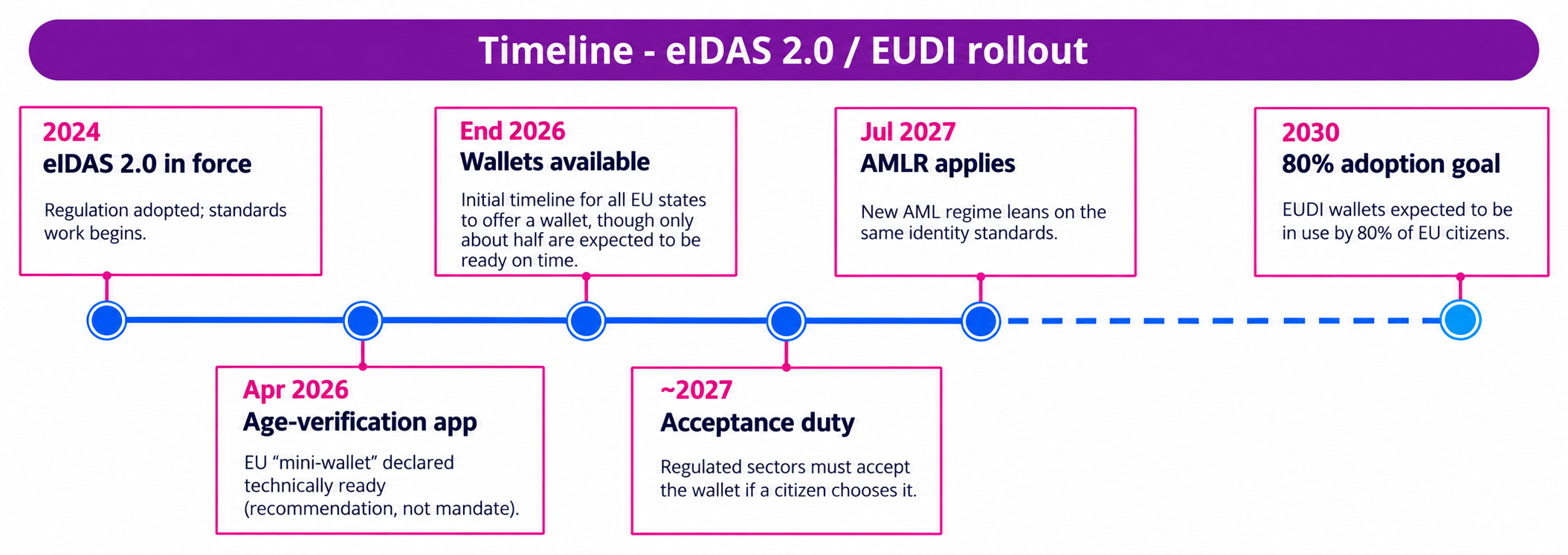
For hotels, the important detail is the timeline and what it actually obliges. Wallets must be functionally available by the end of 2026, and regulated sectors such as banks must be ready to accept them about a year later (2027). Businesses must let a guest prove their identity with the wallet if the guest chooses to, but no one is forced to adopt it in place of a passport or physical ID. It has to be allowed, not made compulsory. Adoption will also be uneven, with current estimates pointing out that only about half of EU member states will be ready on time. For hotels, the practical conclusion is that the EU wallet will be one credential it accepts among several, not a single system that takes over the guest journey.
The payments angle: where identity earns its keep
For a century, hotels have stored identity: passport scans in a drawer, profiles in the property system, documents kept just in case. Digital identity reverses that, so the hotel no longer holds the document but instead receives proof that the guest is who they claim. For a payments audience, the value of digital identity sits in the booking and in fraud, not at the front desk. Hotels carry one of the heaviest fraud burdens in any industry. The category's chargeback rate rose to 0.916% in 2024 from 0.1% a year earlier, it has the highest average dispute value of any sector, and roughly three-quarters of hotel chargebacks are "friendly fraud," where a real guest disputes a charge they made. Across travel as a whole, fraud costs more than $25 billion a year.
Identity helps the most at high-trust moments, meaning sign-up, identity checks and disputes, rather than at the instant of payment, where an extra check would only slow the guest down. Four uses map onto the hotel's problems.

At booking, a guest presents a verified credential - age, identity and residency are confirmed at once, with nothing uploaded or stored. For authentication, the wallet meets strong-authentication rules without the one-time passcodes that cause drop-off. For pre-authorised actions, a guest can approve trusted payments such as the deposit, no-show fee or incidentals once, without re-authenticating each time. And for disputes, tying identity to the booking undercuts the "it wasn't me" claim and leaves the hotel with real evidence.
This raises the real question: which wallet presents that identity, and who owns the system behind it?
Who will control digital identity in hospitality?
The answer is increasingly shared between identity issuers and the wallets that present their credentials, with hotels acting as the orchestrator rather than the owner of the ecosystem. It helps to separate three layers, which together form what the identity industry calls the issuer–holder–verifier model.
Identity issuers provide the underlying trust. These may be governments, such as Singapore's Singpass, the UAE Pass and the future EU Digital Identity Wallet, or bank-led schemes such as Sweden's BankID. Their role is to verify a guest and stand behind that identity, and they are the source of trust that everything else depends on.
Wallets provide a way for guests to present those credentials. Some markets will favour dedicated national identity apps, which run their own experience, while in others credentials may be stored and presented through consumer wallets. Apple and Google, for example, increasingly support government-issued identity such as US state driver's licences and passport-based IDs that can be used at airport security checkpoints. This remains concentrated in the United States and does not replace the physical document, but it shows the direction. If identity sits alongside payment cards in the same wallet, that wallet becomes a powerful intermediary, letting a guest prove who they are and authorise a payment in a single step.
Hotels and their property systems sit where these layers meet, as the verifier. Their role is not to issue credentials or hold identity, but to accept and verify whatever a guest presents, connect it to the booking, and apply it across the stay. As identity fragments across national schemes, bank-backed credentials and consumer wallets, the ability to orchestrate many of them through one smooth guest experience matters more than owning identity itself.
The open questions for hoteliers
Some tensions are still unresolved for hoteliers. The first is the loyalty data trade-off. The extensive personal data a hotel collects at check-in typically feeds its loyalty and marketing engine; yet a verifiable digital ID credential may hand over only a yes/no answer rather than the underlying details. A loyalty programme is a hotel's most valuable data asset and, because account takeovers cause more than half of loyalty fraud, one of its most exposed. Stronger identity can protect the user account while shrinking the data a hotel gathers around it, and each brand will need to weigh in that trade-off differently.
The second is ownership. A city-run check-in system is convenient, but it places the guest relationship, and a store of biometric data, in the hands of a party that is not the hotel. Having already handed distribution to the online travel agents, hotels should think hard before handing over identity too. The third is liability. If a credential turns out to be fake or a check fails, who is responsible: the hotel, the wallet provider, the software vendor or the payment network? The rules do not answer this yet, and hotel contracts will have to.
Conclusion
For hotels, digital identity is best seen not just as a replacement for the passport check at the front desk, but as part of a wider change in payments, authentication and guest trust. The near-term opportunity is to let guests prove who they are and approve payments through trusted digital credentials, cutting friction while improving security.
Looking forward, the same infrastructure could extend beyond human check-in to AI automated booking and payment, as part of the wider shift towards agentic commerce. AI agents already search and book for travellers, and once they can also prove on whose behalf they are acting and pay with verified authority, the credential that smooths a guest's arrival becomes the same one that lets a trusted agent transact. As governments, software providers and payment networks continue to invest in this, identity stops being a check at the door and becomes the trust layer beneath the whole guest journey. For hotels, the task is the same either way: be ready to verify whoever, or whatever, arrives with a digital credential.
How EDC can help
EDC works with hotel groups, payment providers and technology partners on exactly these questions: which credentials to accept in which markets, how identity fits into the existing payments and PMS stack, where it reduces fraud and chargeback exposure, and how to structure vendor contracts so liability sits in the right place. If you are building a digital identity roadmap, or assessing what eIDAS 2.0 means for your properties before the 2026 deadline, we would be glad to talk. Contact us at rohan.shaju@edgardunn.com to arrange a conversation with our hospitality and payments team.
The content of this article does not reflect the official opinion of Edgar, Dunn & Company. The information and views expressed in this publication belong solely to the author(s).
Rohan is a Consultant in the Paris office. Before joining EDC, Rohan worked 3 years in India and France across technology strategy and transformation projects. Since joining EDC in 2023, he has gained valuable payment strategy expertise working with global card networks, issuers, fintech’s and travel merchants. Rohan holds a Masters in Management from ESSEC Business School in Paris, alongside an Electronics Engineering degree from India. Outside the realm of consultancy, Rohan follows cricket, football, and Formula 1. Additionally, he finds solace in activities like cooking, yoga and skateboarding.
%20(1).webp)

%20(1).webp)
%20(1).webp)


