Whitepaper
Download nowSchedule A Call
Schedule a 60min consultation to discuss a potential Payment Orchestration project


Whitepaper
Agentic Commerce: The Next Transformation in How People Shop, Choose and Pay
Agentic Commerce: The Next Transformation in How People Shop, Choose and Pay
Agentic commerce: it is not a “if” question, but more “when”, “where” and “how” it will take hold first
The advent of agentic commerce is no longer a question of “if” – will it happen? But rather a question of when will it happen?, which industry verticals will be first impacted?, and also more importantly how agentic commerce will develop? The fundamental promise of agentic commerce is to facilitate the whole customer purchase process – including search, checkout and payment –, enabling customers to save time when purchasing goods and services and meet requirements to specific requests. And based on our experience at Edgar, Dunn & Company, facilitating the customer purchase process is key for adoption and mass usage. The infrastructure needed to support agentic commerce, including digital wallets, tokenisation, AI assistants, payment APIs and widespread consumer familiarity with digital commerce, is also already largely in place.
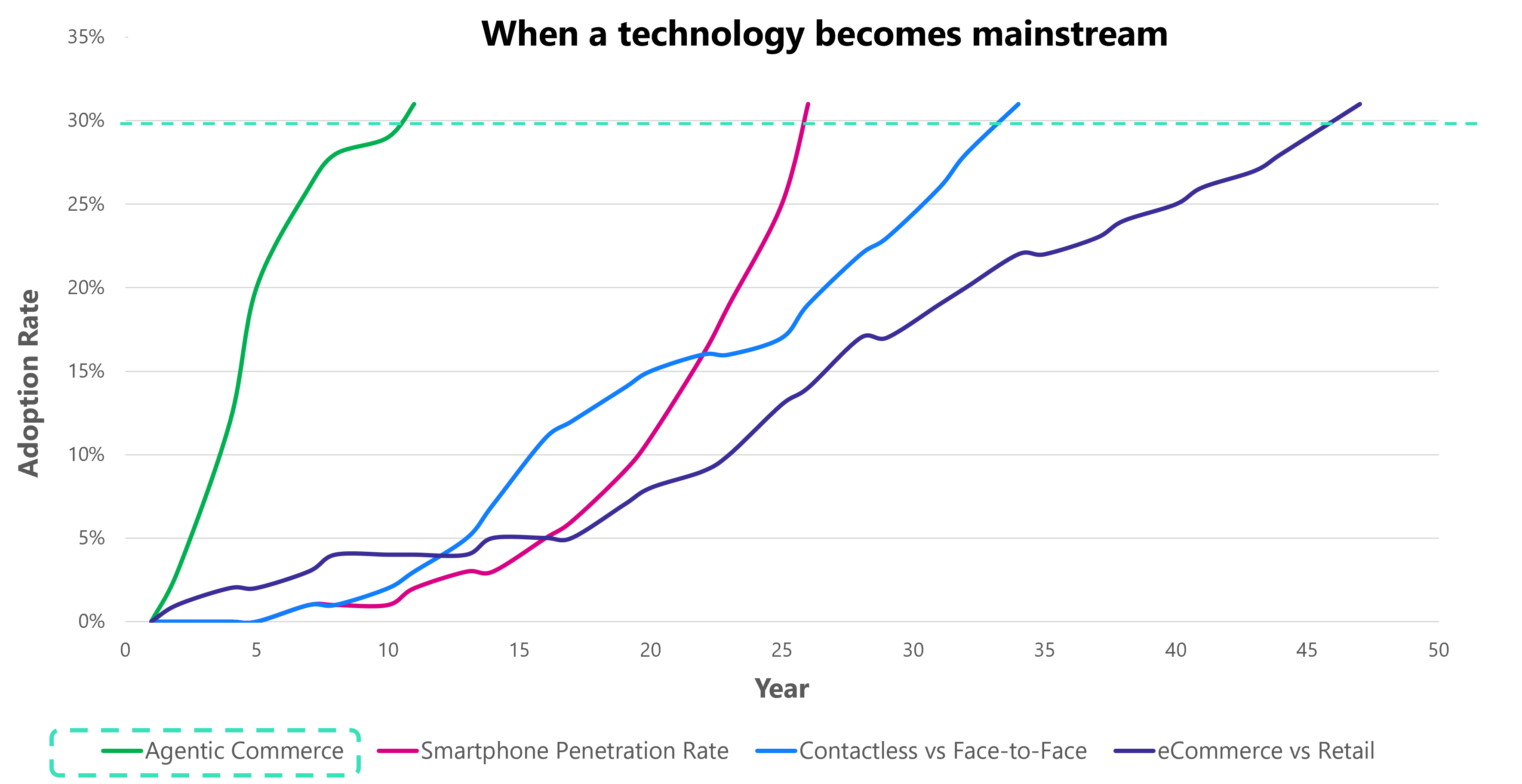
Unlike previous shifts in commerce, agentic commerce builds on existing payment rails rather than requiring entirely new infrastructure. As a result, we expect adoption to accelerate significantly faster than earlier digital innovations. Based on Edgar, Dunn & Company’s analysis, e-commerce and contactless payments each took several decades to reach 30% adoption, while smartphones took around twenty-five years. Agentic commerce is likely to reach the same milestone within five to ten years, making it one of the fastest technology adoption cycles digital commerce has seen.
What is less widely understood is that adoption will not occur uniformly across industry verticals. The critical question is not whether AI agents can make purchases, but for which verticals consumers and businesses are most willing and comfortable to delegate purchasing decisions to agents.
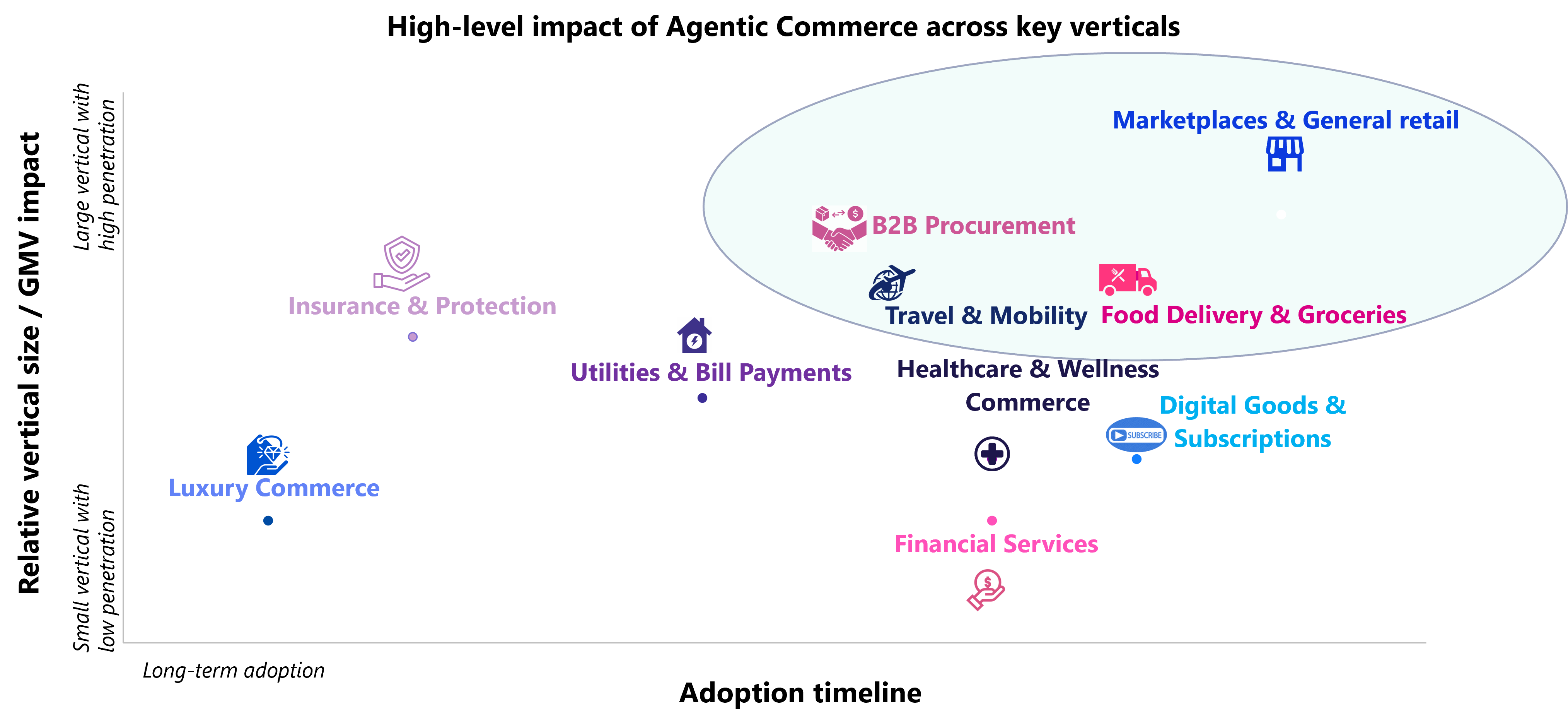
We expect the first industries to embrace agentic commerce will be those where purchasing is frequent, low emotion or highly standardised. These are categories where customers derive little value from the purchasing process itself and instead seek the best outcome across an abundance of choices, making them well suited to AI agents that simplify the overall purchase process. A weekly grocery order, refilling pet food, replenishing office supplies are tasks that can be delegated with little perceived downside. Travel is another vertical where customers need to consider many parameters (e.g., destination, time, class, travel providers vs. intermediaries, price) and AI agents can streamline the search, booking and payment processes.
Marketplaces, general retail, food delivery, B2B procurement and travel are therefore expected to represent the first wave of adoption. These sectors also benefit from high transaction volumes, mature digital channels and relatively clear purchase criteria. Once the regular use of AI agents starts to be ingrained in customer habits, a second wave is likely to emerge as trust, identity and liability frameworks mature. Digital subscriptions, utilities, healthcare and financial services involve greater regulatory, financial or personal considerations, requiring stronger governance before consumers are comfortable delegating purchasing decisions to AI agents. In these categories, the challenge is less about technical capability and more about accountability, consumer protection and confidence when exceptions or disputes arise.
Finally, sectors characterised by emotional engagement, brand affinity or high perceived risk, such as luxury goods and insurance, are likely to be adopted more gradually. In these markets, customers continue to value human judgement, reassurance or the purchasing experience itself, reducing the immediate incentive to automate decisions. Here, AI is more likely to support research and comparison than to replace the customer in the purchase itself. The exception is execution against pre-defined criteria: a customer may happily delegate the task of securing a rare watch or limited-edition handbag the moment it becomes available.
For merchants, the implication is clear. The more repeatable, rules-based and transactional the purchase, the sooner AI agents will become an important customer channel. Organisations operating in first-wave verticals should begin preparing now by ensuring their products are discoverable, machine readable and seamlessly transactable by AI agents. Businesses in later-wave sectors have more time to adapt, but the direction is the same: as trust and governance mature, agentic commerce is expected to become a mainstream route to market across almost every industry. Edgar, Dunn & Company, as a leading global payments consultancy, is ready to assist merchants and payment providers and leverage its in-depth expertise in agentic commerce.

