


Payment & Fintech sector – M&A funding
Share of AI-related deals in total deals (YTD* 2026)

AI-related deals by type (YTD* 2026)
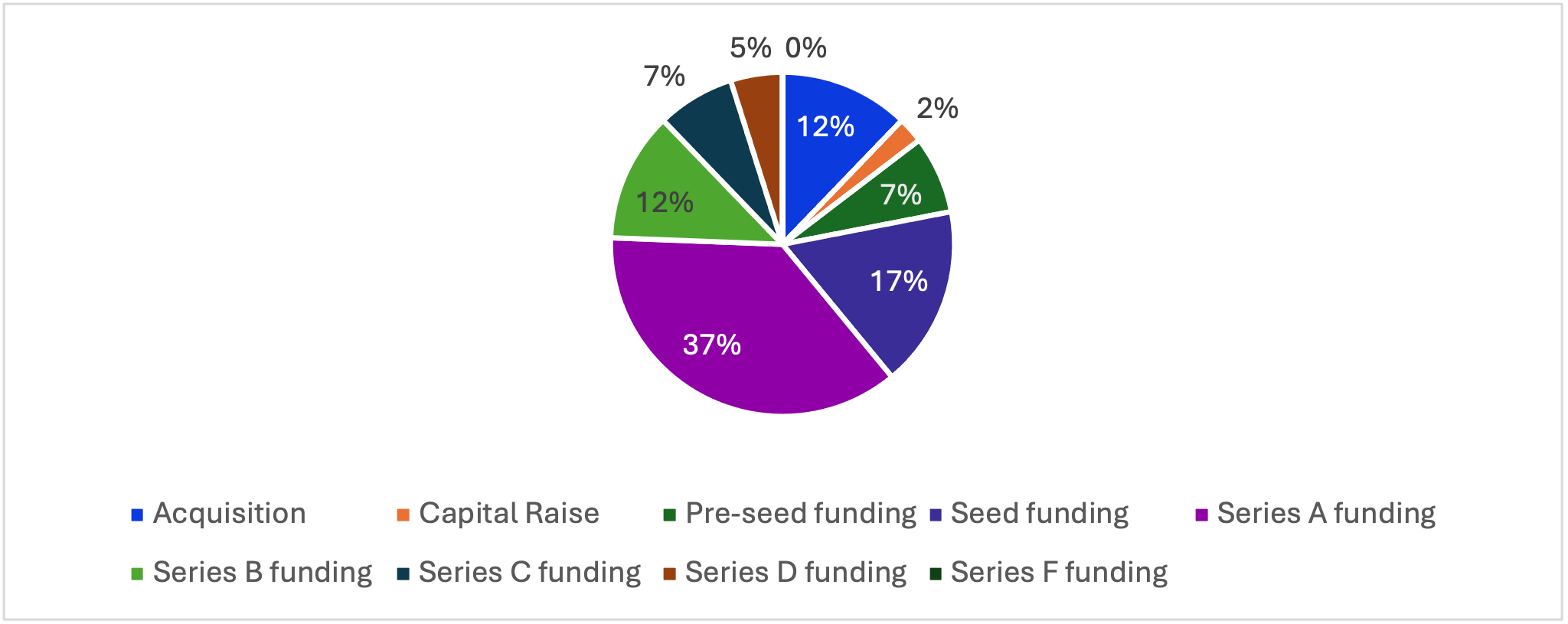
• * Include January-August 2026
Source: EDC
From 2024 to 2025, AI payment related M&A deals jumped from 5% to 9% of the total payments and fintech deals. Investors underwrite AI on fundamentals they trust: recurring transaction models (SaaS revenue), measurable ROI and demand that does not switch off once live (stickiness). These are the key ingredients to attract capital to a business. AI in payments is moving beyond hype and increasingly becoming a conviction investment theme.
Source: EDC
The distribution tells a story: not all segments are equal. Some reflect a decade of proven ROI, others are early bets still searching for them. Understanding the difference is where the analysis brings value. But capital placed is not value delivered. In 2024, Klarna gradually replaced 700 of its agents with its Open Ai powered chatbot. The agent was set to close tickets fast. On paper, it worked: resolution time dropped from 11 minutes to under 2 minutes, and a $40 million profit improvement was expected in 2024. But the quest for a single metric optimisation led to other problems. Follow-up contacts surged by 25% and customer satisfaction scores dropped abruptly. Klarna’s chatbot missed one element: solving client problems. By 2025, the firm walked back from the all-AI approach and rehired human for its customer support services. This is a clear AI capital-vs-value gap: the investment delivered the efficiency it was geared for but failed to convert it into an actual pay-back. Resolution speed looked great while the real value, retained and satisfied customers, leaked out the back. So where does AI actually create economic value in payments?
Through three value drivers: reducing losses (fraud, disputes, compliance), cutting operating costs (manual effort, processing), or growing revenue (higher approval, conversion, acceptance). Every credible AI use case should trace back to at least one of them.
- However, value drivers alone are insufficient. AI only delivers economic value when three conditions exist:
- Condition 1: It tackles a problem with too many shifting or context-specific cases for fixed rules to be successful (e.g., fraud)
- Condition 2: It feeds on clear feedback loop to learn from
- Condition 3: There is enough data to learn on
Condition 1 is the critical one. If the problem keeps changing too much for fixed rules to keep up, that's where AI earns its place. In this article, we deliberately set aside agentic commerce. It is still nascent, with too few deployments at scale to quantify ROI honestly. EDC has written on it extensively elsewhere.
Reducing losses: AI’s proven track-record
Visa and Mastercard have used AI for decades. According to Visa, it has developed AI-based technology since 1993. Visa offers today more than 100 solutions powered by AI and deep learning capabilities. Cybersource Decision Manager and Smarter Stand-In Processing (STIP) are among these. Mastercard has used AI just as long and in multiple use cases including predictive card compromise detection, real time fraud detection or network-level attack defence systems.
At this time, this form of AI was then called “neural networks” and was almost exclusively applied to fraud detection and authorisation optimisation at the network level. Networks would generate real time scoring to issuers, who would use that intel to make transaction declines/approvals more accurately.
Later rebranded Machine Learning (ML), it worked because it addressed the right problem: massive transaction volumes, identified clear patterns and even considered the economic impact of false positives vs. false negatives in the bigger picture. The ROI was there and the industry never questioned the business case. The reason is exactly the above thesis: all three conditions held at once. Fraud is costly, its patterns shift constantly, every transaction comes back labelled fraud-or-not, and the data is enormous. That is what real economic value looks like when the conditions align.
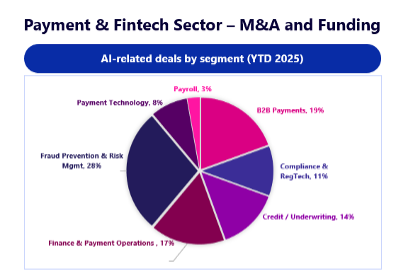
In 2025, the Fraud Prevention & Risk Management segment (28%) is still the one that attracts most of the AI investment in the payment landscape. More than B2B payments, or credit underwriting.
For networks, AI did not stop at fraud management. As e-commerce exploded after the internet bubble in early 2000, friendly fraud became a structural problem for the retail industry. Studies estimate that friendly fraud represents 60 to 80% of all chargebacks. Mastercard forecasts friendly fraud to increase by 24% between 2025 and 2028 as e-commerce continues to grow. The trouble is considered big enough to attract large investments. Among the interesting use cases is Chargeflow. Chargeflow raised a $35 million Series A in November 2025 and the platform today powers more than 15,000 merchants globally.
But what makes the dispute management industry particularly interesting is that we are standing at the intersection of two generations of AI. Predicting which disputed transaction to challenge or accept is ML; nothing new. Automatically drafting the evidence and tailoring each representment argument is generative AI (Gen AI): the same reasoning layer behind the LLM tools (Claude, ChatGPT, Le Chat) we now use every day. The difference is fundamental: where ML detects patterns, Gen AI interprets context, synthesises information, reasons across multiple steps and creates new content. So dispute management is not a bet; it is a live use case, with measurable ROI for more than 15,000 retailers.
Compliance and Reg Tech is probably where Gen AI is working most effectively today. Every payment transaction (e.g., wire transfers or cross-border transactions) carries a compliance obligation. Banks handle millions of transactions weekly, just the AML monitoring would generate hundreds of alerts every month. Most of these would likely be false positives requiring manual investigation. This is precisely the kind of high-volume, language-intensive, pattern-recognition work that Gen AI was built for. Here, Gen AI is not solving the false positives, rather, it reduces the time spent on alert investigation by automating the narrative drafting, surfacing relevant context, and flagging the cases that genuinely warrant human review. The losses it cuts are not fraud losses but compliance ones, the cost of investigation, and the regulatory risk of missing the alert that mattered. A compliance officer from a global issuer I met at the 2026 CPI Europe summit in London was exactly the concrete example needed to picture it. She mentioned that their team had recently deployed an AI assistant to automate AML compliance workflows. It is a small anecdote, but an illustrative one. Gen AI is not penetrating the core of the payment operation itself. It is quietly taking over everything around it. The payment back-office work that nobody sees, but that consumes an enormous amount of human time.
Reducing operating costs: where Gen AI is bringing back-office value
If loss reduction is AI’s proven ground, cost reduction is where it is expanding the fastest today. In October 2025, Rohan Shaju from Edgar, Dunn & Company described in his “AI’s growing influence on payments and fintech dealmaking” article that B2B payments are being reshaped by AI, particularly across spend management, accounts payable and receivable and treasury. The use case is concrete here. Gen AI extracts structured data from invoices, automates reconciliation, generates payment responses and manage exemptions. Tasks previously managed by finance teams can now practically run on autopilot.
One interesting use case: Xelir. This fintech raised $160 million in Series B funding from Insight Partners for its agentic AP automation platform. The platform embedded Gen AI throughout the workflow to manage invoices, emails, reconcile statements, and generate responses. For the corporate, the ROI business case is simple: fewer error, faster cycle times and redirection of resources from recurring manual processes to higher-value work.
Reconciliation is where the variability condition shows its edge. In simple, single-source environments with clean data, reconciliation is a solved problem: good deterministic matching and rules handle it, and the added value of AI is marginal. But in complex, high-volume, multi-source environments with different formatting data (e.g., a global airline with a multi-acquiring strategy), matching becomes genuinely hard, and that is where AI starts to earn its place. Take airline payments. A provider like Accelya handles reconciliation for 160+ airlines across a network of 190+ acquirers, and notes that moving to a multi-acquirer setup makes reconciliation markedly more complex and time-consuming. Multiple sources, inconsistent formats, missing references: this is exactly the high-variability environment where AI starts to earn its place, not the clean single-acquirer flow that good rules already handle.
In the introduction chart, credit and underwriting represent 14% of total AI investment. Gen AI is not replacing ML for credit decisioning; it is transforming everything around it. Where analysts once spent hours drafting credit-approval memos, risk assessments and underwriting summaries, Gen AI now produces them in seconds. The same line that separates flagging a fraudulent transaction (ML) from understanding why a dispute was filed (Gen AI) separates scoring a credit application (ML) from drafting the decision rationale around it (Gen AI). The value here lays in the operating cost optimisation.
Growing revenue: an opportunity that is still maturing
The third value driver (growing revenue) is perhaps where the Gen AI opportunity is less mature today. Higher approval rates, better conversion, smarter acceptance: the pitch is compelling, but this is where the three conditions most often fail to line up, particularly when the AI label is applied to solutions that remain largely rules-based.
Is Gen AI shifting the trade credit decisioning? Not really. Traditional risk approaches force businesses to offer payment terms to only their safest, best-known customers. The trade credit decisioning and offer rate expansion is primarily driven by ML-based credit scoring models using alternative data, not Gen AI specifically. It is the same engineering as the one powering the credit decision or the fraud prevention tools.
Payment orchestration is probably the clearest example of AI overpromising. Conducting Payment Orchestration RFPs for merchants has allowed me to look under the hood of several engines labelled as delivering the “AI smart routing experience for optimal performance”. The reality? Most of what vendors call dynamic AI routing is, in practice, static rules with some A/B testing layered on top. True real-time AI optimisation (dynamically routing transactions based on live performance signals) would require enormous volume of client specific data (condition 3) and robust feedback loop. What merchants are buying today is “intelligent routing”. It is very useful, but not powered by AI.
“Payment personalisation” is also an area where the AI label is overly used. The promise of AI dynamically surfacing the optimal payment method and offering a personalised checkout experience for each customer sounds compelling. The reality is more sober. Implementation often relies on geolocation, device detection and basic purchase historic data.
While the opportunity for Gen AI to drive revenue remains relatively limited today, as data availability and feedback loops improve, we expect its role in revenue optimisation to develop further.
Conclusion
AI in payments is neither the revolution that can be claimed by enthused vendors nor an overhyped distraction described by sceptics. The M&A 2025 data tells a more nuanced and consistent story.
Where Gen AI delivers today is value on the upstream and downstream processes that surround payments – not the payment infrastructure itself. It turned human and time-consuming payment back-office tasks into automated processes. The “plumbing”, that includes the authorisation, clearing, routing and settlement remains deterministic and rule based.
Dynamic decision based on real time data also tells the same story. It works where it has always worked: fraud detection and credit scoring. Beyond these 2 areas, Gen AI decisioning remains very limited in the payment stack. Today, markets seem to be rewarding AI that wraps around payments. Use cases for Gen AI to structurally replace existing rails has not emerged yet.
Interested in discussing Agentic Commerce and how this emerging trend could affect your organization?
We would be happy to continue the conversation.
Louis Wapler
louis.wapler@edgardunn.com
Tue To
tue.to@edgardunn.com
The content of this article does not reflect the official opinion of Edgar, Dunn & Company. The information and views expressed in this publication belong solely to the author(s).
Louis is a Senior Manager at the Edgar, Dunn & Company Paris office. He has joined the firm in March 2021 and has graduated with an MBA from ESCP Business school in 2020. Prior to joining EDC, Louis has combined 7 years of experience in the banking and aviation industries. Louis enjoys witnessing the modernisation of payments and payment related processes in B2B ecosystems that drive the ongoing change of the financial institutions landscape. When Louis is not supporting clients in various markets to solve payment problems, he will play competitive golf and plan surfing trips.
%20(1).webp)

%20(1).webp)

.webp)


