
.webp)

Tickets for major festival events and headline music gigs, such as Taylor Swift’s Eras Tour, the Oasis reunion, or the Glastonbury Festival are renowned for selling out within minutes of release. This phenomenon is driven by an immense demand from loyal fans, limited capacity at venues, and the additional pressure of ticket reselling or ticket touts and bots buying large portions of allocations for resale at higher prices. The live entertainment ticketing market faces a critical supply and demand imbalance, resulting in near-instantaneous sellouts for premium events.
Agentic commerce, a form of shopping powered by Artificial Intelligence (AI) agents, is expected to bring profound changes to event ticketing. AI agents are set to automate queueing for ticket release, price comparison and purchasing which will fundamentally reshape both the user experience and how the typical ticketing models operate.

Live event ticketing in the UK, for example, is huge and has grown by approximately £2 billion of sales since the pre-pandemic 2019 levels. By 2024, the global live events industry exceeded pre-pandemic peak. 2024 to 2028 growth in ticket sales is estimated to be 20% according to EDC. Total ticket sales in 2028 are expected to be in the region of £6.5 billion. Agentic Commerce is expected to serve £2.4 billion worth of ticket sales in the UK by 2028 (37% of total sales). This will be driven by high adoption rates in the “arena” and “large venue” categories whereas other venue categories will have slower adoption due to a mix of direct ticket sales and brand loyalty.
This article examines the impact on consumer access and how AI could change the event ticketing market. While AI technologies and agentic commerce offer mechanisms to combat some of the existing problems, they will also introduce new challenges in the payment checkout step that could fundamentally reshape live event ticket sales. Today, or at least before agentic commerce becomes mainstream, consumers buy tickets for live music gigs, festivals, and theatre events via a variety of routes, each operating different commercial terms for the consumer, the artist or theatre company and venue. These include:
- The ticket agent or broker, serves as an intermediary between consumer and venues and artists. These agents operate official ticketing websites, such as Ticketmaster, SeeTickets, AXS, and Eventbrite handle direct sales for events. These are often where tickets first go live and sell out quickly for high demand shows.
- Many theatres and concert venues offer tickets for their events through in-person and online box offices, providing a trusted and direct route to secure seats.
- Dedicated music and theatre sites like ATG Tickets (for London West End shows), Central Tickets (seat filler and discounted deals), Skiddle (festivals and club nights), and TodayTix (last-minute theatre tickets) aggregate events for easier browsing and purchase.
- Secondary/Resale Marketplaces including StubHub, SeatPick, and Viagogo offer resale tickets for sold-out events. These can be priced above face value and should be used with caution. Some, such as SeatPick, aggregate listings to help fans find the best deals among verified resellers.
- Promotions and Artist Presale allocations are frequently offered to fan club members, credit cardholders, such as the American Express Presale Tickets, O2 Priority, or newsletter subscribers, allowing early access before general release. Amex Presale gives cardholders access to purchase tickets for high-demand events, such as concerts, festivals, and theatre before they go on general sale to the public. O2's loyalty program, called ‘Priority’, is a rewards system available exclusively to O2 mobile customers. O2 customers can purchase tickets for thousands of gigs, concerts, and events across the UK up to 48 hours before they go on general sale to the public.
The Agentic Commerce Ecosystem
To explore the influence of agentic commerce on the event ticketing market, first we need to understand that there are currently three types of foundational models that are shaping the agentic commerce ecosystem:
- Business-to-Agent (B2A): where businesses interact directly with AI agents representing consumers, tailoring their offerings to algorithmic decision-making. For example, a ticket agent or the venue provides APIs that let personal AI agents query prices and availability. In this model, the AI agent would be working on behalf of the consumer, like ChatGTP or Claude.
- Agent-to-Consumer (A2C): in which autonomous agents serve or sell directly to human users, providing tickets. For example, a ticket agent or the venue creates its own AI agent that curates the event tickets according to the consumer preferences. In this model, the AI agent will operate under the brand of the ticket agent or the venue serving the consumer. Ticketmaster is already using AI and voice-driven agents to enhance event discovery, but this falls short of the true definition of A2C agentic commerce.
- Agent-to-Agent (A2A): where AI agents independently negotiate, collaborate, or transact with one another, forming a fully automated layer of commerce. E.g., where a buyer's AI agent communicates with a ticketing agent or the venue's AI agent to autonomously discover tickets, compare seating arrangements, negotiate terms, and complete purchases.
At this point in time, the emerging use cases of agentic commerce mostly concentrate on B2A and A2C models. In contrast, the A2A model is expected to have a significant impact in the future, but the necessary technology and compliance frameworks are still far from reaching the required level of maturity.
Queuing for tickets
There is a case where an AI agent could queue for an event for tickets to be released and purchase them on behalf of the customer. This is a very current and fascinating area of AI. While the concept of a fully autonomous AI agent waiting in a virtual queue and completing the entire ticket purchase on behalf of a customer is the goal. This is mostly being explored through experimental platforms right now, rather than being a widely available service.
Agentic AI agents are goal-driven systems that can handle a high-level request, such as "Get me two cheap tickets for the Oasis concert next March" and break it down into a multi-step process starting with search, which compares prices, checks seating, and initiates the purchase. Today, technology companies are rolling out features that assist the customer, but usually stop short of the final, autonomous purchase, especially concerning queues. Google, for example, has launched ‘agentic capabilities’ in its AI search mode. You can ask it to find tickets for a specific event with preferences, for example, "Buy me two tickets for the Coldplay concert, next July in Barcelona, prefer standing floor near the front of the stage". It can quickly search multiple third-party ticket websites (StubHub, etc.) in real-time, curate the best available options, and present a list of prices and seats. The final purchase requires the human user to click a link and complete the transaction manually on the provider's site. It does not automatically join a virtual queue and process the payment and the CAPTCHA required when tickets are first released. A CAPTCHA (Completely Automated Public Turing test to tell Computers and Humans Apart) is a type of challenge-response test used on many ticketing websites to determine whether the user is a human or a bot. It helps prevent automated software bots from spamming, hacking, or abusing e-commerce websites.
Ticketing companies are typically using highly sophisticated anti-bot, challenge-response CAPTCHA tests, and randomised queuing technology specifically to stop automated scripts, software bots and, by implication, autonomous AI agents from gaining an unfair advantage over human buyers. This needs a fundamental re-think before agentic commerce for event ticketing starts to gain momentum.
AI Agents buying tickets
Today, an AI agent cannot, on its own, provide the two independent authentication factors required by regulations such as the European Union’s Payment Services Directive (PSD2), as these are fundamentally designed around human interaction. Current regulations such as the EU's PSD2 were not written with autonomous AI agents in mind, leading to legal questions regarding liability if an AI agent initiates an unauthorised transaction or makes an error.
Mastercard announced in April 2025 its Agentic Payments Program. The program is being developed with partners such as PayPal, Stripe, Microsoft and Google to enable AI-powered commerce, and its global rollout means it will be available in Europe and other regions after rollout in the US. As stated in the press release - “Mastercard is transforming the way the world pays for the better by anticipating consumer needs on the horizon,” said Jorn Lambert, Chief Product Officer at Mastercard. “The launch of Mastercard Agent Pay marks our initial steps in redefining commerce in the AI era, including new merchant interfaces to distinguish trusted agents from bad actors using agentic technology. Recognising the seismic implications of this evolution, we are keen to collaborate with industry players to advance the standards for agentic payments, such as applying the Model Context Protocol (MCP) to Secure Remote Commerce. This lays the foundation for scale and builds trust in agentic commerce.” Citi and US Bank Mastercard cardholders were the early adopters in 2025 of Mastercard’s Agent Pay.
The Agentic Payments Program provides a new tool to enable AI assistants and agents to access Mastercard's API documentation. This will be via its MCP server and interpret it using structured, machine-readable content, with the aim to support integration with platforms such as Claude and AI coding tools such as GitHub Copilot. Mastercard are collaborating with OpenAI, Google, and Cloudflare to develop safety and authentication standards for autonomous transactions.
Google also announced its AP2 (Agentic Payments Protocol 2) – another protocol for agentic commerce. Around the same time, Visa is rolling out new tools to help secure agentic commerce transactions. Underpinning these frameworks is Cloudflare’s Web Bot Auth technology, developed in collaboration with Microsoft, Shopify, Checkout.com, Worldpay, Adyen and others.
As if there were not enough announcements, OpenAI and Stripe also have their agentic commerce framework that allows consumers to buy things directly within a ChatGPT conversation without leaving the chat interface or having to navigate to a separate website. OpenAI and Stripe co-developed the Agentic Commerce Protocol (ACP), an open standard designed to be the foundational infrastructure for this new AI-led commerce.
E-commerce is expected to shift from ‘search, click, and buy’ to ‘ask, decide, and buy.’ At the time of researching this article, Agentic Commerce acts as the ultimate researcher and negotiator, but the customer still holds the ‘buy’ button. However, OpenAI and Stripe, are aiming to make the fundamental shift from AI being an assistant to being an actor that completes the purchase. Currently, this is only available in the US market. Etsy was the first merchant built on this framework. OpenAI/Stripe is not fully compliant with the rigorous payment regulations in the European Union and the UK.
Back in the world of event ticketing, CM.com, an AI-powered Customer Engagement Platform, founded in the Netherlands, has a product called Helo that supports large ticketed events such as the Dutch Grand Prix. Halo helps to automate customer service and manage repetitive tasks. By using AI agents CM.com are able to find the best tickets and then create a payment link for the customer to then click on to complete the purchase. To automatically make a ticket purchase and get around the Strong Customer Authentication (SCA) which is commonly used by ticketing platforms across Europe and the UK sounds is a challenge. There are potentially two approaches.
- Firstly, the AI agent generates a secure payment link within the conversational chat window. This link is tied to the reserved ticket which is hosted by CM.com’s Payments Platform, allowing the user to click it and complete the payment using a variety of payment methods (e.g., credit card, iDEAL, PayPal, etc.). This is obviously not fully autonomous.
- The second approach is where the consumer’s preferred payment method has been pre-registered. In this full "Agentic" experience the AI agent is authorised by the user to trigger the purchase directly using these stored credentials. Once payment is confirmed, the AI agent automatically the ticketing platform to issue the digital ticket and send the confirmation/ticket via the customer's preferred channel (e.g., via email, WhatsApp, or directly into the event app).
Is this like Trusted Beneficiaries (or Whitelisting) under the PSD2's SCA regulation? Under Whitelisting the trust is between the customer and the merchant. Once whitelisted, the merchant can initiate future payments without SCA. However, in Shared Payment Token as described by OpenAI/Stripe, the trust is effectively delegated to the AI Agent/Platform. The token is a one-time key for a specific, customer-initiated purchase. It doesn't create a permanent trusted relationship with the merchant. It acts more like a Merchant Initiated Transaction (MIT) or a transaction already covered by an SCA exemption based on the token's nature, avoiding the need for a separate SCA during the chat flow.
Mastercard in the UAE, for example, supported the first AI agentic commerce transaction outside the US in November 2025. In this use case, cardholders were able to use their AI agent to search, discover and transact through Mastercard Agent Pay, to make a booking at VOX Cinemas. A relatively closed example for a specific merchant but this does illustrate the payment technology for event ticketing will work autonomously end-to-end, from search to purchase.
What’s Next?
The long-term impact of agentic commerce on the event ticketing industry is difficult to say. This is because the deployment of agentic commerce in the event ticketing industry is currently in its nascent phase, resulting in limited market penetration. Technically, the payments industry is working to solve the challenges of security and trust in autonomous AI initiated payments. Meanwhile, from the ticketing industry perspective, for many years companies have deployed sophisticated anti-bot technology, like CAPTCHA, to stop automated scripts (including agentic commerce AI agents) from gaining an unfair advantage over human buyers. This will have to change if ticketing companies wish to embrace AI.
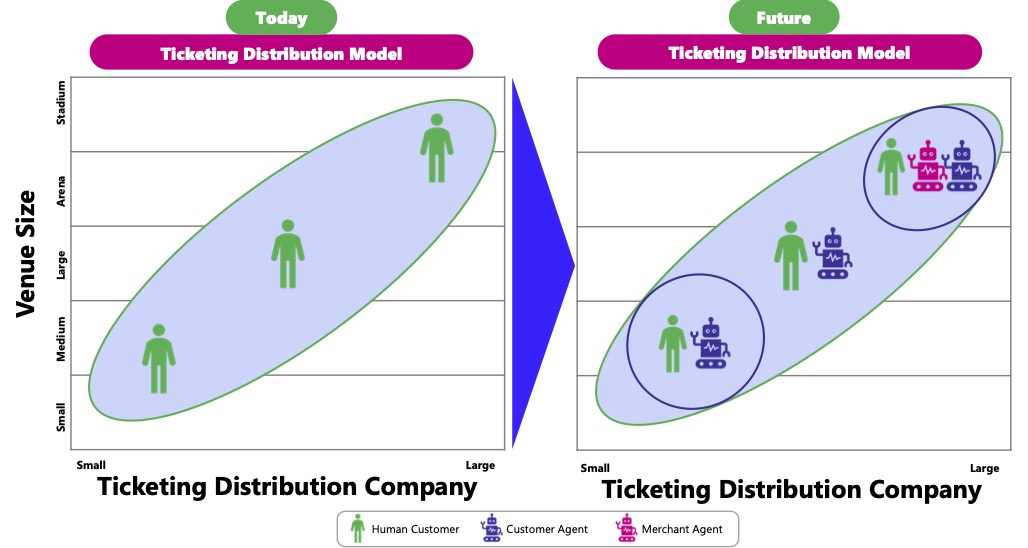
Will ticketing agencies and ticketing companies go out of business because of agentic commerce? Not necessarily. While traditional ticket agencies are expected to face disruption, many will survive or transform by embracing AI and automation to enhance the customer experience. As illustrated in the graphic above, the size of the venue and ticketing distribution companies will have a significant influence as to where AI agents will play a role. AI agents will be able to autonomously search multiple ticket platforms for the best prices, availability, and seat locations, then complete purchases without human involvement. This could reduce the reliance on traditional ticket agencies and brokers who curate and sell tickets. Smaller ticketing agencies, small distribution channels and niche brokers are expected to go out of business as agentic commerce will simply bypass and disintermediate these players. Venues of all sizes will serve human customers and AI agents. The larger venues are expected to create their own merchant AI agents to enhance ticket sales for human customers and other AI agents acting on behalf of customers.
As AI agents increasingly act as the buyer’s proxy, ticket sellers and resellers may need to optimise their offerings for agent discovery rather than direct consumer targeting. Branding and marketing will evolve to earn agent trust and prioritise agent “discoverability.” Integration of agentic commerce payment protocols will allow seamless, secure, and frictionless ticket purchases at scale, potentially bypassing cumbersome checkout flows and reducing the risk of fraud through AI-driven authorisation, such as the Shared Payment Token. Ticketing agencies that evolve by incorporating agentic commerce technology, offering tailored concierge-like AI services, or monetising agent ecosystems may thrive. Those that do not adapt risk disintermediation or reduced margins.
EDC has several decades of working with leading retailers and merchants to optimise payment acceptance and processing. Agentic commerce is expected to fundamentally reshape the payment operating models. The EDC Retail & Hospitality payments team have proven experience of navigating the toughest payment challenges, uncovering breakthrough opportunities, and building robust mitigation strategies to handle tomorrow’s risks. EDC can empower your business to stay ahead of the innovative developments in the payments industry.
Research Contribution: Reuben Joseph (Business Analyst, London) provided the primary and secondary research foundational to this article.
The content of this article does not reflect the official opinion of Edgar, Dunn & Company. The information and views expressed in this publication belong solely to the author(s).
Mark is a Senior Advisor in the London office and heads up the Retailer & Hospitality Payments Practice for EDC. He has over 25 years of experience of consulting strategy in the payments and fintech industries. Mark works with leading global merchants, and payment suppliers to retailers and hospitality merchants, to develop omnichannel acceptance strategies. He uses the 360° Payment Diagnostic methodology developed by EDC to identify cost efficiencies and new growth opportunities for retailers and hospitality merchants by defining an appropriate mix of payment methods, acceptance channels, innovative consumer touchpoints, and optimizing Payment Service Providers and acquiring relationships. Outside the payments and fintech industry Mark is a passionate snowboarder.
%20(1).webp)

%20(1).webp)


