


A few years ago, many software platforms were still deciding whether they wanted to get into payments. That part is largely settled now. For marketplaces and vertical software platforms, payments are increasingly becoming part of the core business model rather than just an integration in the background. Global embedded payment transaction volume is projected to surpass $2.5 trillion by 2028, growing at a CAGR of 23%.
The more relevant question has shifted from whether to offer payments to how much of the payments experience to own.
Consider a restaurant management platform that provides point-of-sale software, online ordering, reservations, and back-office reporting. Initially, the platform may simply integrate a third-party payment provider. Over time, however, the platform may recognize that payments are central to daily operations and begin embedding them more deeply into the product experience, owning onboarding, improving acceptance rates, and layering in financial services such as instant payouts or working capital.
As this shift happens, payments move from a backend integration to a core economic and strategic lever.
Why Payments Became Strategic
Customer expectations have evolved. Small and mid-sized businesses (SMB) increasingly expect their software providers to simplify operational complexity across workflows, including payments, reconciliation, reporting, disputes, financing, and payouts. 84% of businesses say they would explore financial products from their software platform if offered, and 76% say they would pay a premium for a one-stop solution. In many verticals, users now expect those capabilities to feel integrated rather than fragmented across multiple vendors.
At the same time, the economics have become more compelling for platforms operating at scale. SMB adoption of vertical-specific software has nearly doubled over the past six years, reaching 64% in the U.S. in 2024, up from 34% in 2018. Once payment adoption reaches meaningful volume within that installed base, transaction revenue can become an important complement to subscription revenue, particularly for platforms with strong retention and frequent payment activity.
Payments also create operational and behavioral data that many software platforms would otherwise struggle to access directly. Transaction flows can provide insight into customer cash flow patterns, seasonality, retention trends, refund behavior, and operational health. This data can also support broader product expansion into areas like capital, treasury services, or other financial workflows.
Infrastructure Is Usually the Real Constraint
If merchants experience failed transactions, onboarding delays, poor reconciliation, or inconsistent support, adoption tends to slow quickly regardless of the pricing model behind the scenes. Nearly half of UK retail merchants name slow or failed transactions as the primary reason they abandon a payments provider entirely. Payments ultimately become part of the customer experience, and reliability matters more than most platforms initially expect.
There are several operational layers that tend to matter most.
- Reliability: authorization performance, uptime, settlement accuracy, and consistency of payment execution.
- Scalability: A payments setup that works for one geography or customer segment may become significantly more complex as a platform expands into new markets, supports larger merchants, or introduces additional payment methods. Regulatory and acquiring environments can vary materially across regions.
- Operational Readiness: Payments introduce support and compliance responsibilities that many platforms underestimate early on, including disputes, underwriting reviews, chargeback management, refunds, reconciliation, and merchant risk monitoring.
Platforms typically need enough visibility and control to shape the customer experience and resolve operational issues without relying entirely on third parties.
The Spectrum of Ownership
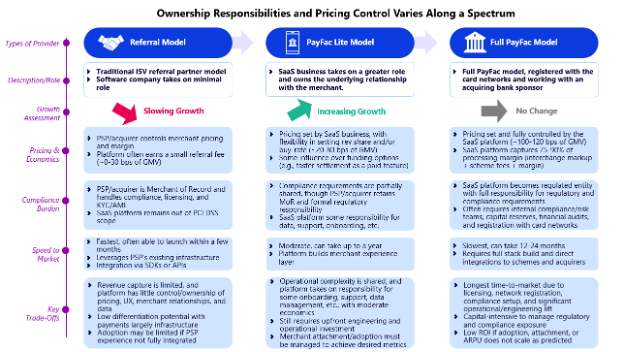
One of the more important shifts in embedded payments over the past several years has been the emergence of more flexible ownership models. Historically, the decision was relatively binary: either refer merchants to a third-party processor or become a full payment facilitator and take on significant operational and regulatory responsibility. Today, there is much more middle ground, and that is where most of the market activity is happening.
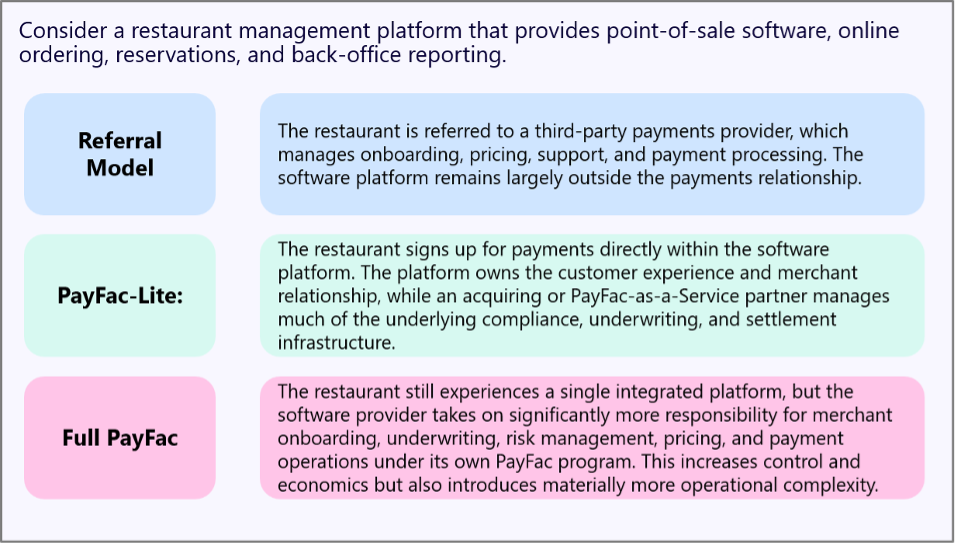
For example, platforms such as Shopify and Mindbody operate embedded payments models that combine elements of PayFac-lite and full PayFac structures depending on region, acquiring relationships, and product configuration.
Starting Light: Referral Model
At the lightest end of the spectrum, platforms refer merchants to a payments provider that manages onboarding, compliance, underwriting, settlement, and ongoing support. For early-stage platforms, this can be an entirely reasonable approach. It allows the company to launch quickly, minimize operational burden, and test customer demand before investing more deeply in payments infrastructure
The tradeoff is that the platform typically owns relatively little of the customer relationship within payments. The provider often controls pricing, merchant servicing, data access, and portions of the user experience.
Going Deeper: Full PayFac
At the other end of the spectrum are platforms that become full payment facilitators. This model gives the platform significantly more control over merchant onboarding, pricing, settlement flows, support experience, and payments data, and it can create more flexibility to expand into adjacent financial products over time.
Toast provides a useful example of this evolution. What began as a restaurant technology platform expanded payments into a core part of its offering, allowing merchants to manage payments alongside their broader operational workflow within a single platform.
But becoming a PayFac changes the nature of the business operationally. Compliance, underwriting, merchant risk management, and financial operations become core competencies rather than outsourced functions. The support burden increases materially. A full buildout typically takes more than a year and requires direct card network registration. That registration still runs through a sponsoring acquirer, which continues to provide the bank relationship and settlement rails even after the platform takes over the merchant experience.
Card network and acquiring program rules also introduce thresholds for merchant scale and risk exposure within a PayFac structure. For example, Visa guidance includes additional requirements when a sponsored merchant’s annual Visa volume reaches around US$1 million, at which point the merchant may need to be more directly reflected in the acquiring relationship, while still often remaining within the PayFac’s servicing and operational framework.
The Middle Ground: PayFac-Lite
The growth of PayFac-lite infrastructure has probably been one of the most important developments in the embedded payments market over the last several years. These models allow platforms to control more of the customer experience and participate more in the economics without taking on the full regulatory and operational burden of becoming a registered PayFac. In practice, this allows software platforms to maintain ownership of the merchant relationship and onboarding experience while relying on a payments partner (an acquirer or a PayFac-as-a-Service provider) to operate much of the underlying payments infrastructure.
That middle layer has made embedded payments accessible to a much broader set of software platforms. In 2019, only 35% of businesses bought software and payments together. That figure jumped to 45% after the pandemic, and Worldpay projects that 70% of payments accounts will be bundled with software by 2027.
What This Means for PSPs and Acquirers
This evolution also changes the role of payment providers themselves. Platforms are no longer simply distribution channels for acquiring services. Many platforms now have a much more sophisticated understanding of payments economics, infrastructure design, and ownership tradeoffs than they did even a few years ago. 91% of ISVs say they expect embedded payments to play a larger role in their growth strategy over the next twelve months.
The providers positioning themselves most effectively tend to share a few characteristics.
- They lead with operational performance rather than purely economic conversations. Early in the journey, most platforms care more about onboarding speed, reliability, flexibility, and support quality than maximizing every basis point of margin. 44% of ISVs cite integration complexity as the main barrier to going deeper into payments, which means providers who make that first step easier tend to win more of the long-term relationship.
- They recognize that different platforms require different levels of ownership. The needs of an early-stage vertical software platform are very different from those of a scaled enterprise marketplace operating across multiple geographies. Providers that can meet platforms where they are, and offer a credible path forward as they grow, are better positioned than those pushing a single model regardless of fit.
- They increasingly position themselves as long-term infrastructure partners rather than simply payment processors. As embedded payments becomes more deeply integrated into software workflows, the operational relationship between platform and provider becomes significantly more strategic.
The Bottom Line
The embedded payments opportunity is substantial, but the most successful platforms understand that revenue is typically the outcome of execution, not the starting objective.
Merchant onboarding, payment performance, support operations, and workflow integration ultimately determine adoption and trust. Platforms that get those fundamentals right are not only better positioned to capture payments revenue, but also to expand into broader financial services over time.
In embedded payments, infrastructure is what creates the right to monetize.
Interested in discussing BaaS, Embedded Finance, and how these emerging trends could affect your organization?
We would be happy to continue the conversation.
Samee Zafar, CEO
samee.zafar@edgardunn.com
Tue To, Head of Fintech
tue.to@edgardunn.com
The content of this article does not reflect the official opinion of Edgar, Dunn & Company. The information and views expressed in this publication belong solely to the author(s).
Tue To is the Head of Advanced Payments and Fintech for North America, operating from our San Francisco office. With more than 15 years of experience in strategy consulting, she brings a wealth of expertise to her role. Tue’s expertise spans various areas, including payment processing, card networks, mobile payments, international remittances, and emerging technologies. Her global experience in strategy and product development has helped clients across the globe optimize their payment operations, identify new business opportunities, and implement innovation solutions to drive growth and profitability through a combination of strategic thinking and practical insights. Tue holds a B.A. in Economics and Mathematics from Grinnell College and an MBA from Columbia Business School. Outside of work, Tue enjoys photography and trying new cuisines.
%20(1).webp)

%20(1).webp)


.webp)

