
.webp)

Food delivery platforms spent years competing on speed, restaurant selection, and aggressive promotions. But the next disruption may be far bigger: consumers no longer opening food delivery apps themselves.
AI-powered assistants are beginning to reshape digital commerce. Instead of manually browsing restaurants and entering payment details, consumers may rely on AI agents to select and purchase meals on their behalf. Ordering food could become as simple as asking an assistant to “find something healthy nearby that can arrive within 20 minutes”.
The timing matters. Sales in food delivery exploded during and after the pandemic, but after years of hypergrowth, the industry is now saturated in most markets. Platforms are fighting less for new users and more for engagement, retention, and order frequency.
In that context, Agentic Commerce is more than simply another feature. According to Deliverect, personalisation, convenience, and AI-driven customer experiences are becoming key differentiators shaping the next phase of growth.
The shift towards AI-assisted ordering has already started
While Agentic Commerce may still sound futuristic, many platforms have already started deploying AI-driven ordering and recommendation capabilities.
Instacart was one of the earliest food-tech players to experiment with conversational commerce through its partnership with OpenAI. In 2023, the company launched a plugin allowing users to generate recipes, build shopping lists, and order groceries directly from a conversation with ChatGPT:
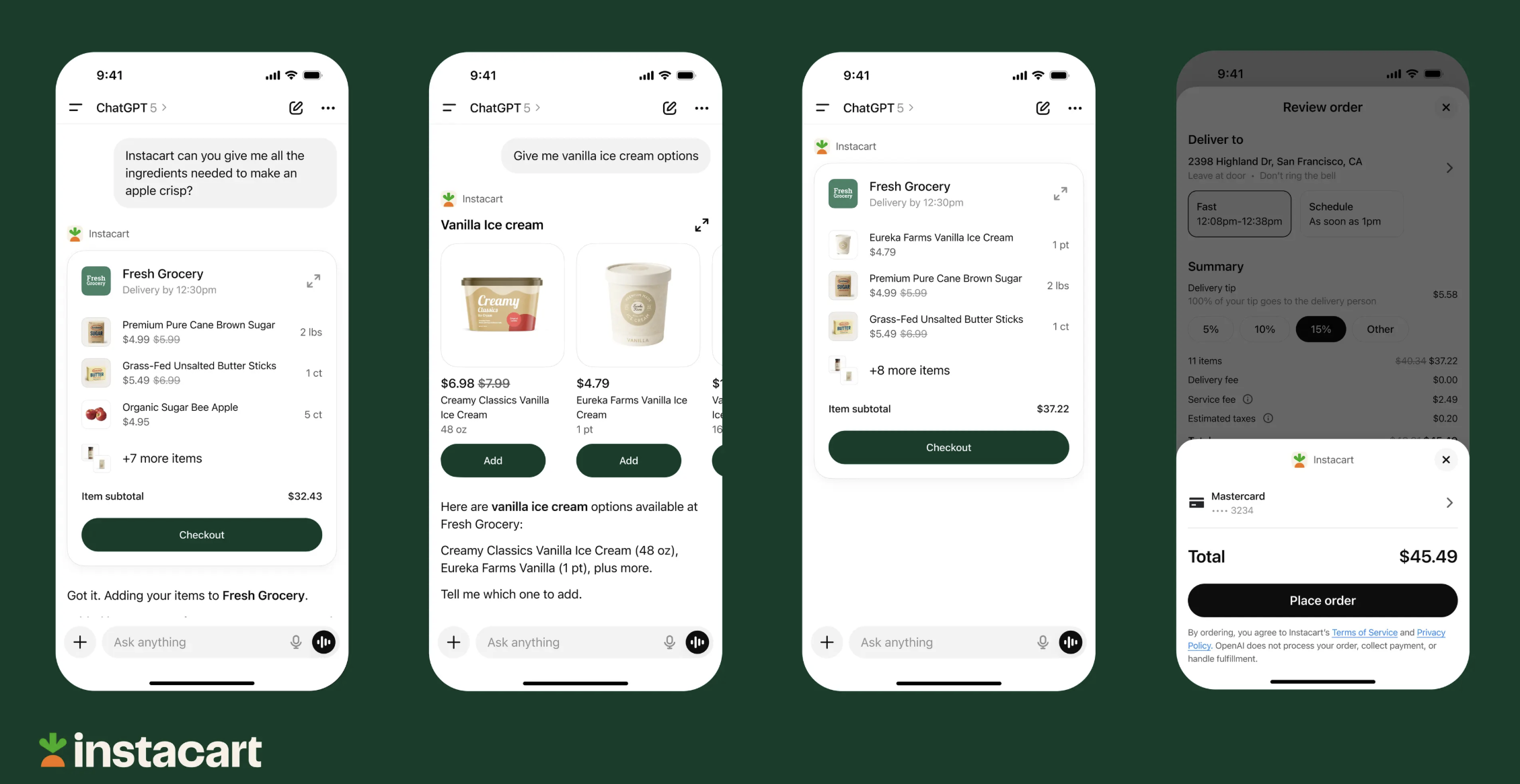
Since then, Instacart has continued expanding its AI capabilities through Ask Instacart, an AI assistant embedded directly into the app allowing users to ask questions such as: “what should I cook for a vegetarian dinner party?”; “what ingredients do I need for tacos?”; “what’s a healthy breakfast idea?”.
More broadly, this reflects a shift from traditional search-based commerce toward intent-based commerce with AI handling discovery, comparison, checkout, and payment in the background. For example, Uber Eats recently launched an AI-powered grocery cart assistant capable of generating checkout-ready carts from text or image prompts, further reducing friction in the ordering journey.
And the next evolution could push automation even further. OpenAI recently showcased Operator, an AI agent capable of autonomously navigating websites and completing tasks online. While not food-delivery specific, such agents could eventually browse delivery platforms, compare restaurants, enter payment credentials, and complete orders without the consumer directly interacting with the app.
However, not all AI-enabled ordering experiences have proven successful so far. DoorDash, for example, ended its AI voice-ordering pilot for restaurants in 2025 after testing the solution for nearly two years. The feature aimed to automate phone orders for busy restaurant staff, but the company ultimately cited product-market fit and customer demand as key reasons for discontinuing the initiative.
This illustrates an important distinction: while conversational AI and autonomous agents may significantly transform discovery and digital ordering journeys, replacing human interaction in real-time customer service environments remains operationally challenging for many restaurant use cases.
For platforms, the battle is shifting from logistics to interface ownership
For years, food delivery platforms competed on faster deliveries, broader restaurant coverage, denser rider networks, and lower delivery fees. But Agentic Commerce could weaken many of these traditional advantages. If consumers increasingly order through AI assistants rather than directly through branded apps, the value may shift away from logistics and towards whoever controls the customer interaction layer.
This is already visible in other parts of digital commerce, where consumers discover and purchase products through platforms such as TikTok Shop rather than directly through merchant websites or apps. Since 2022, TikTok Shop has also allowed users in the UK to purchase groceries and fresh food directly through the platform, further blurring the lines between social commerce, retail, and local delivery services.

Food delivery could follow the same trajectory. As AI assistants start selecting the “best” option based on price, delivery time, dietary preferences, or previous behaviour, consumers may progressively care less about which platform fulfils the order. In that scenario, delivery platforms risk becoming interchangeable fulfilment layers operating in the background.
Value shifts towards whoever controls:
- The recommendation engine (i.e., discoverability)
- The customer data
- The AI interface itself
- The payment credentials
This is why large technology ecosystems may become particularly powerful in the next phase of food delivery. Companies already controlling search, operating systems, voice assistants, or messaging ecosystems are naturally positioned to intermediate food delivery transactions.
As ordering journeys become more automated, payments must evolve
Consumers interacting with AI assistants will not tolerate failed transactions, repeated authentication requests, or slow checkout experiences. Payments need to happen instantly and seamlessly in the background.
Food delivery platforms have already spent years reducing checkout friction through stored payment credentials, one-click checkout, embedded wallets, and subscription ecosystems such as Uber One or DashPass. Agentic Commerce pushes this logic even further: human consumers may no longer actively manage the payment journey at all. It will be an AI agent.
This makes payment infrastructure even more strategic. Payment orchestration, tokenised payments, and intelligent fraud management will become critical in ensuring transactions happen smoothly and invisibly. In an Agentic Commerce environment, a failed payment or poor checkout experience could simply push the transaction to another platform automatically.
At the same time, frictionless should not mean invisible to the point of losing consumer trust. Consumers still expect transparency and control over subscriptions, recurring payments, and purchasing decisions. Recent scrutiny around Uber One subscription practices highlights the importance of maintaining transparency and user control, even as commerce and payments become more automated.
In other words, if AI starts deciding where consumers order from, payment performance may decide which platforms AI chooses in the first place.
In summary
The food delivery industry spent the last decade optimising logistics. The next decade may focus on optimising autonomous commerce.
For platforms, the challenge is no longer only about faster deliveries or larger restaurant networks. Customer interaction, payment performance, and ecosystem stickiness may determine which players capture the most value.
Agentic Commerce is therefore not simply another feature or innovation trend. Importantly, it should not be treated as another sales channel. It may fundamentally redefine where value sits in the ecosystem and it must be treated as a new type of consumer. Agentic Commerce is firstly a non-human consumer, that is governed by a human consumer.
In the next article of this series, EDC will explore why food delivery platforms are expanding beyond meals, and how grocery, retail, pharmacies, subscriptions, and local commerce services are becoming critical growth and retention levers.
Note: By leveraging its proprietary 360° Payments Diagnostic product, EDC helps food delivery, retail, and digital commerce players assess payment performance, reduce checkout friction, and identify opportunities to improve conversion, customer experience, and profitability in AI-driven and automated commerce environments. Early 2025, EDC also launched an internal AI Taskforce dedicated to helping clients better understand the implications of AI and Agentic Commerce across the payments ecosystem. The EDC AI Taskforce has conducted almost 100 interviews with merchants in the last 10 months and continues to refresh its knowledge of how merchants are planning for and responding to Agentic Commerce.
The content of this article does not reflect the official opinion of Edgar, Dunn & Company. The information and views expressed in this publication belong solely to the author(s).
Charlotte is a Senior Consultant based in Paris. She holds a master’s degree in management (with a finance specialisation) from Kedge Business School, Marseille. Charlotte gained 7 years of experience working as a finance and strategy specialist in France and in India and worked for some of the largest corporates, including Deloitte, L&T Technology Services in Mumbai, Société Générale Corporate & Investment Banking in France, and India. At EDC, Charlotte works on a variety of client projects, from project kick-off through to strategy conceptualisation, with colleagues in San Francisco, Dubai and London. Charlotte loves skiing and enjoys traveling around South Asia.
%20(1).webp)

%20(1).webp)


